
Leah Mata Fragua
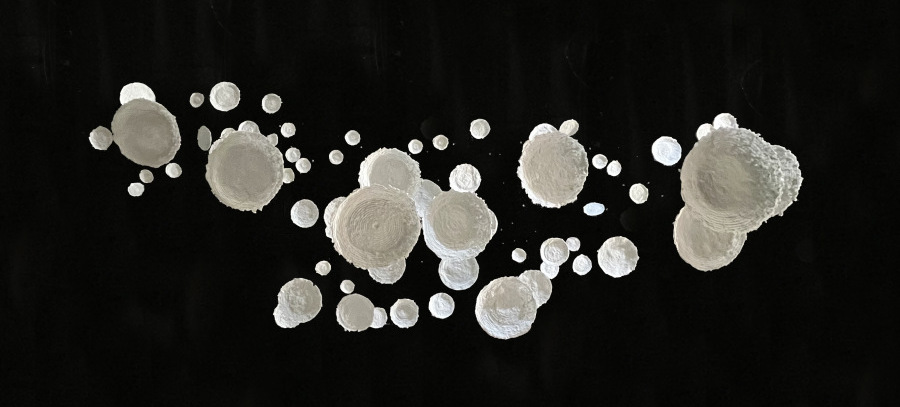
Sky Snake
2026
Handmade paper baskets abaca, indigo, thread, and suspension hardware; ceiling-mounted installation
Approximately 8′ x 4′; variable suspension heights
This ceiling-mounted installation of handmade paper basket forms is arranged as a flowing celestial field. The work draws from Chumash sky knowledge and considers the sky as a relational field: a place of movement, timing, balance, and orientation.
The forms are based on Chumash star baskets and the importance of the Milky Way within Chumash worldview. Suspended together, the baskets become a murmuration of light, individual forms moving in relation to one another, gathering into a larger pattern across the space. I am thinking about the basket as objects for cultural transmission, but also as a form that can hold movement, direction, and star knowledge.
The silver mica causes the paper to shift as viewers move through the installation. The baskets gently catch the light, creating a space that feels both tangible and atmospheric. This piece connects Chumash visual culture with the night sky, transforming the basket shape into a space for reflection, movement, and ongoing conversation between humans and they world we experience.
Lydia Tjioe Hall
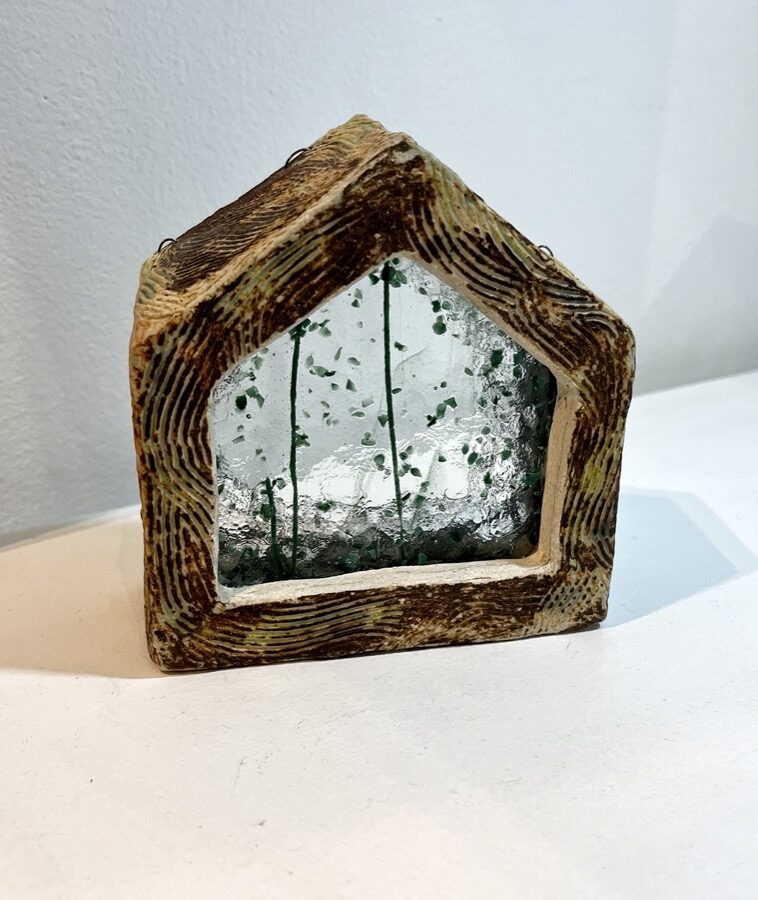
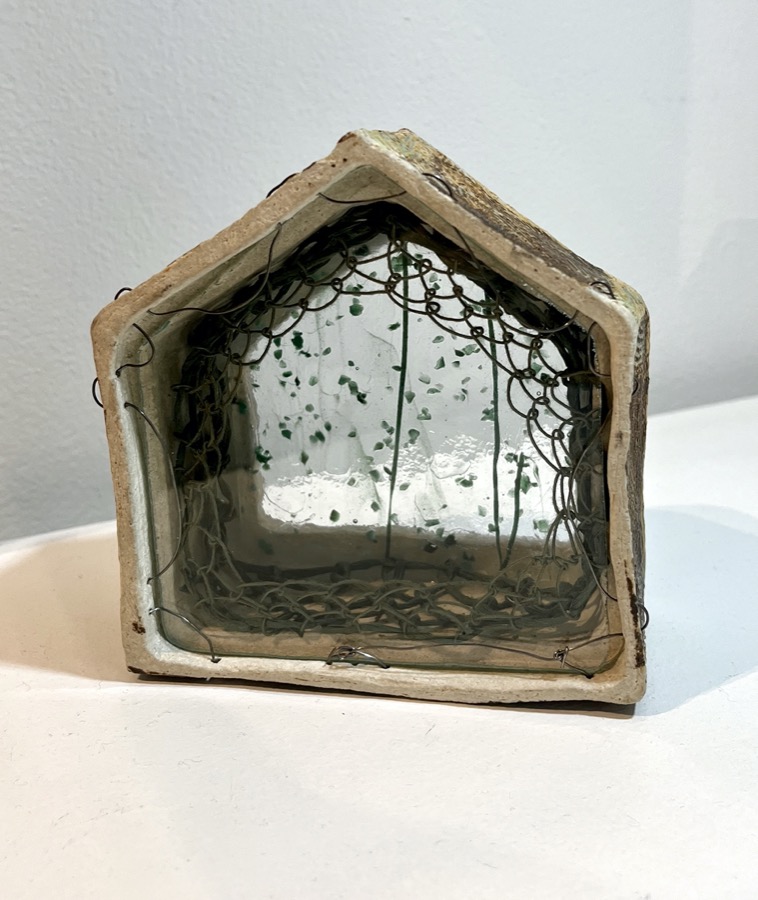
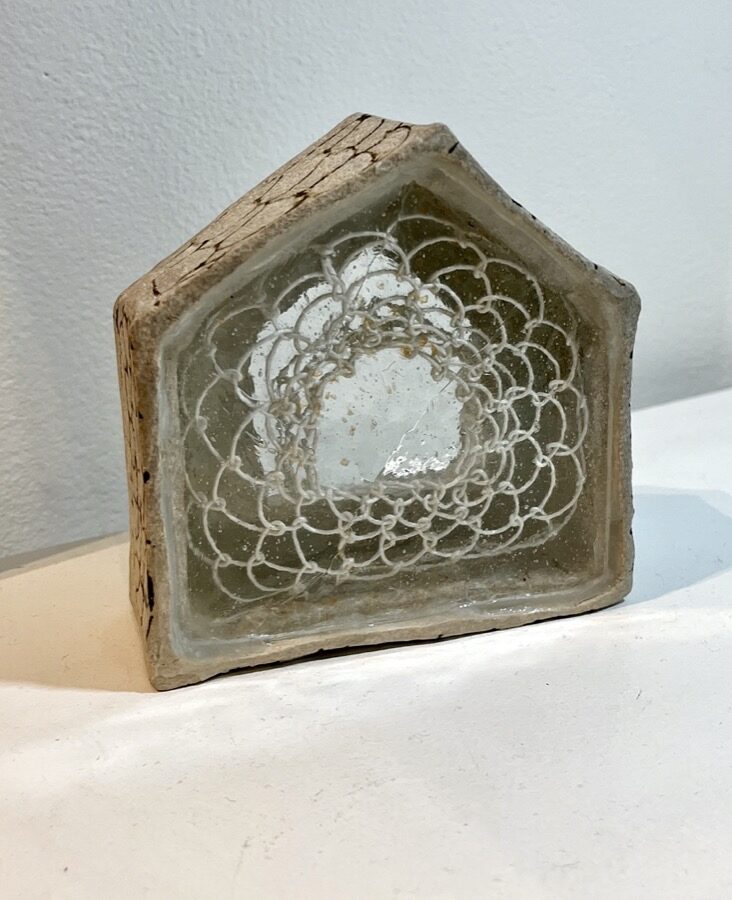
Green Glass House
2026
Stoneware, glass, green cloth covered wire
Lydia Tjioe Hall
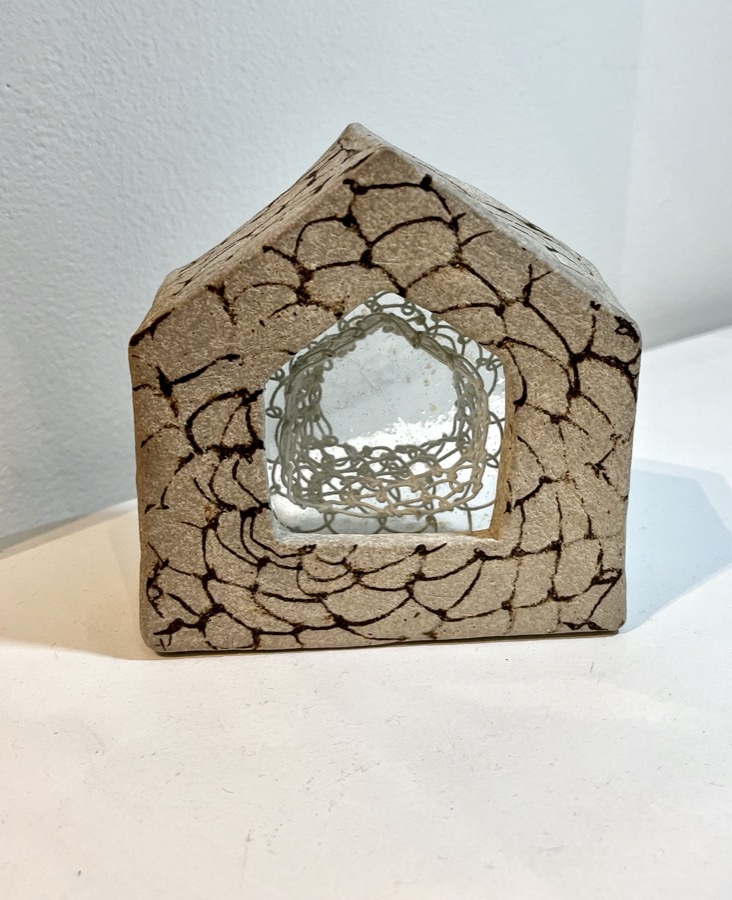
Glass House with White Interior
2026
Stoneware, glass, white cloth colorwire
Lydia Tjioe Hall
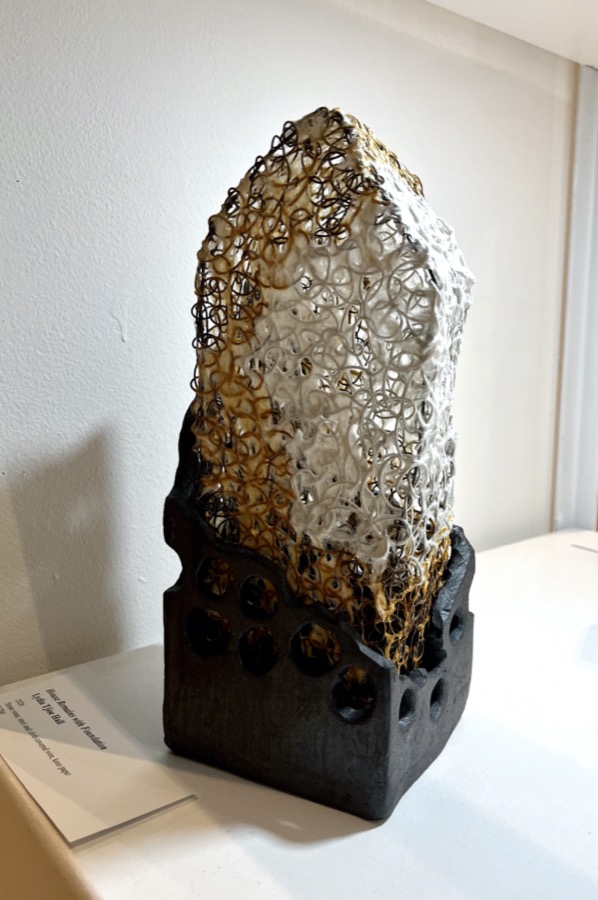
House Remains with Foundation
2026
Stone wear, steel and cloth covered wire, kozo paper
Lydia Tjioe Hall
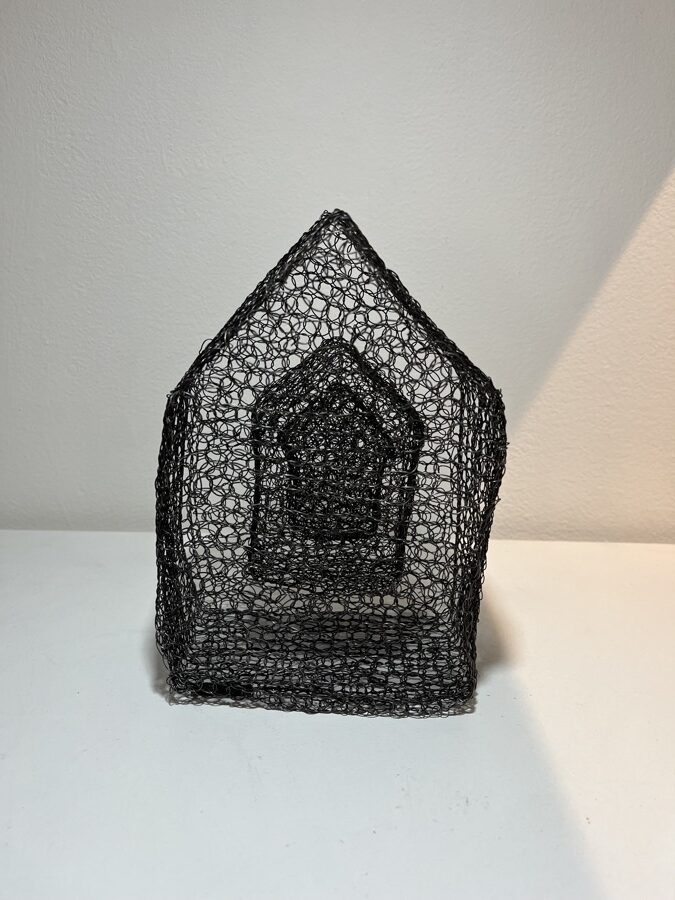
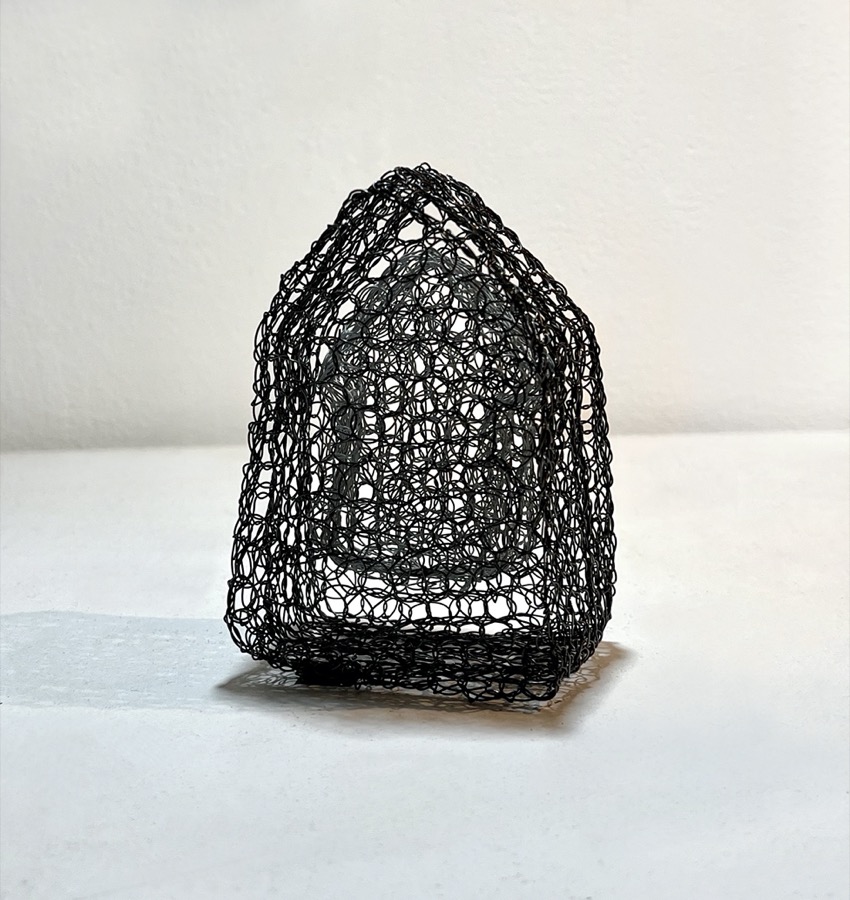
Three Nesting Houses Within
2021
Steel wire
Lydia Tjioe Hall
House with White Interior
2025
Steel and white coated wire
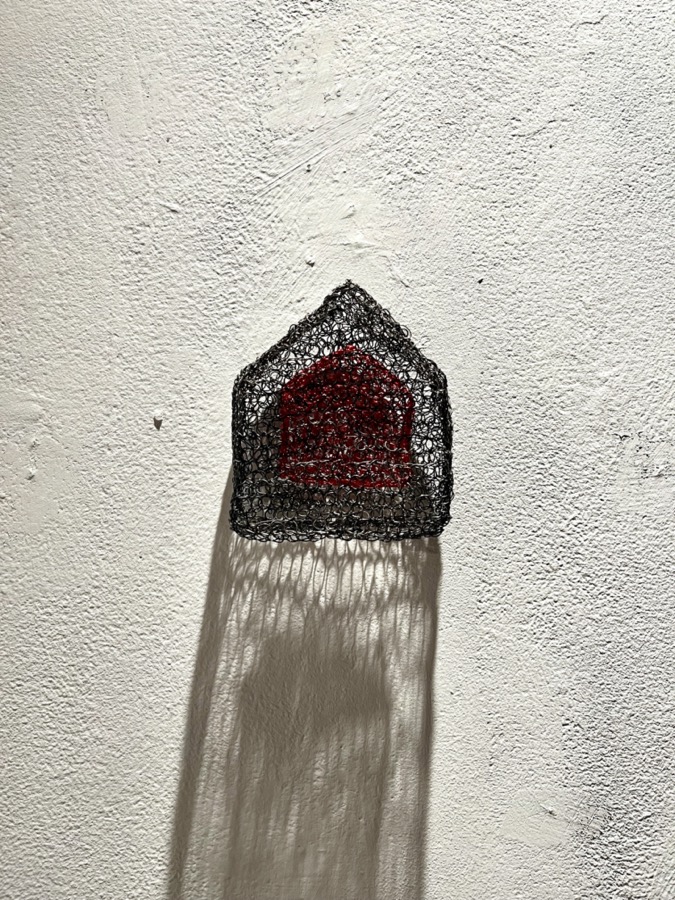
Lydia Tjioe Hall
House with Red Interior
2025
Steel and brass wire
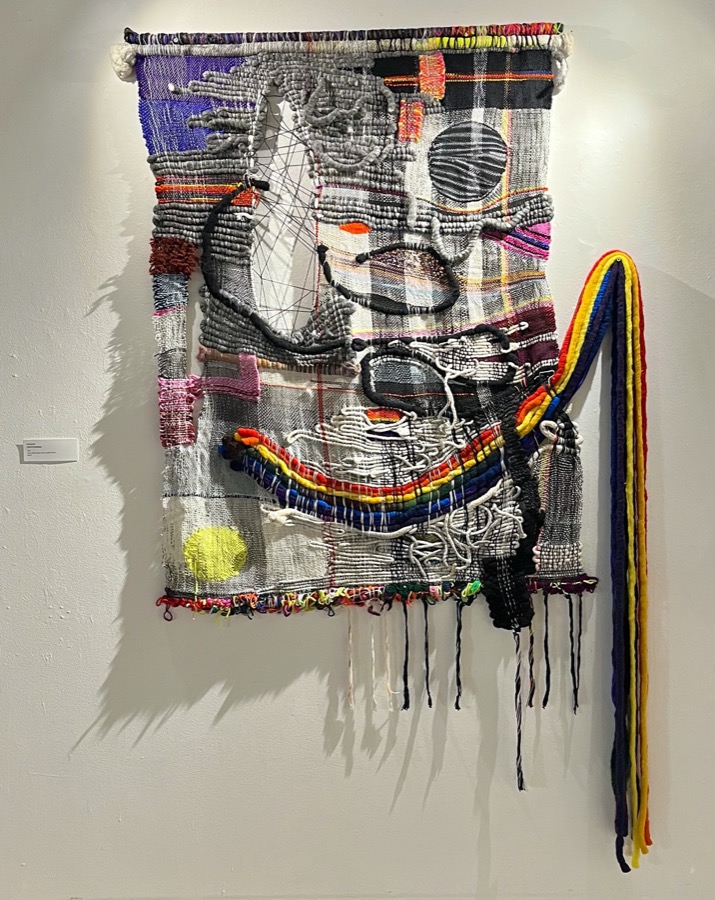
Terri Friedman
Oxytocin
2018
Wool, cotton, hemp, acrylic, metallic fibers
Hello Uncertainty
Stay Astonished and Oxytocin are part of a series created after the 2016 presidential election culminating in an exhibition titled ‘Hello Uncertainty’, 2019. They document the climate of anxiety and uncertainty we experience collectively. And, despite a corrosive environment around us, how do we live with heartbreak and gratitude at the same time? The works are purposefully optimistic. Oxytocin is a ‘happy’ hormone that our bodies produce. The piece has an upside down rainbow smile that slides off the piece. Stay Astonished is framed in by a neon orange sky inciting a similar excitement but also anxiety.
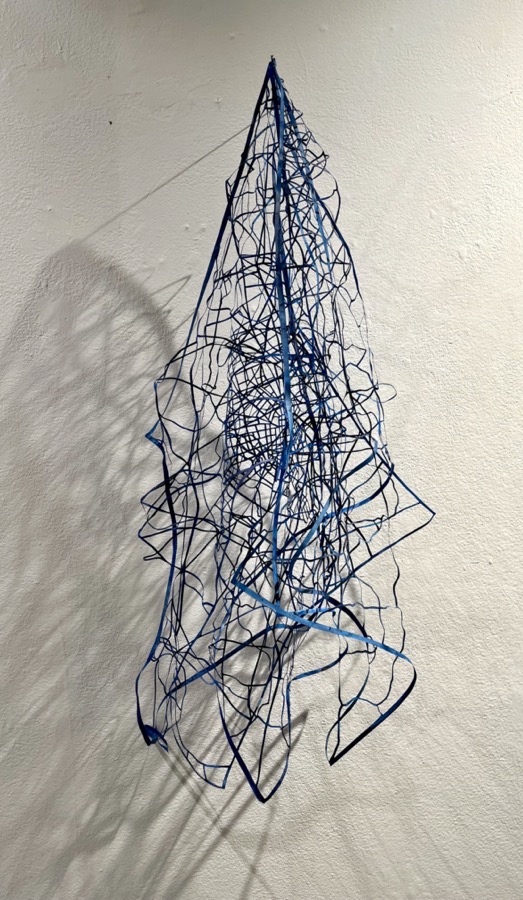
Linda Ekstrom
Traversal
2006, 2025
Cut paper maps, Flashe paint and ink, rod
Maps from three different unidentified areas of the US have been altered by cutting away the land leaving only the lines of roadways and borders. These demarcations allow access and also create divisions, barriers and boundaries.
The skeletal maps are lifted away from the land where one might imagine it again in its original terrain, before human intervention.
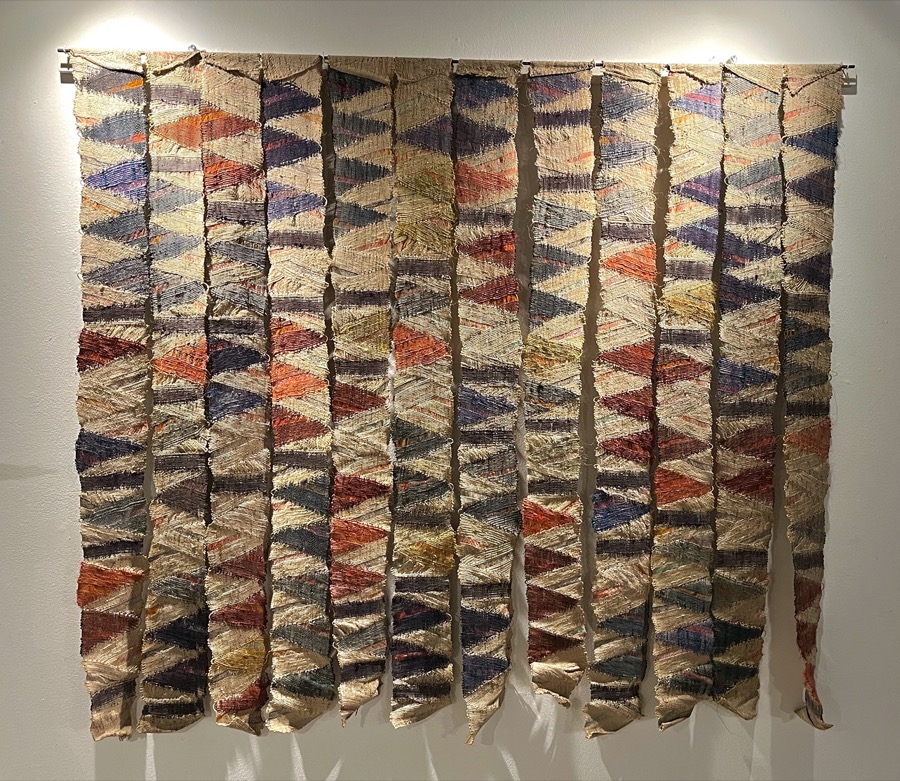
James Bassler
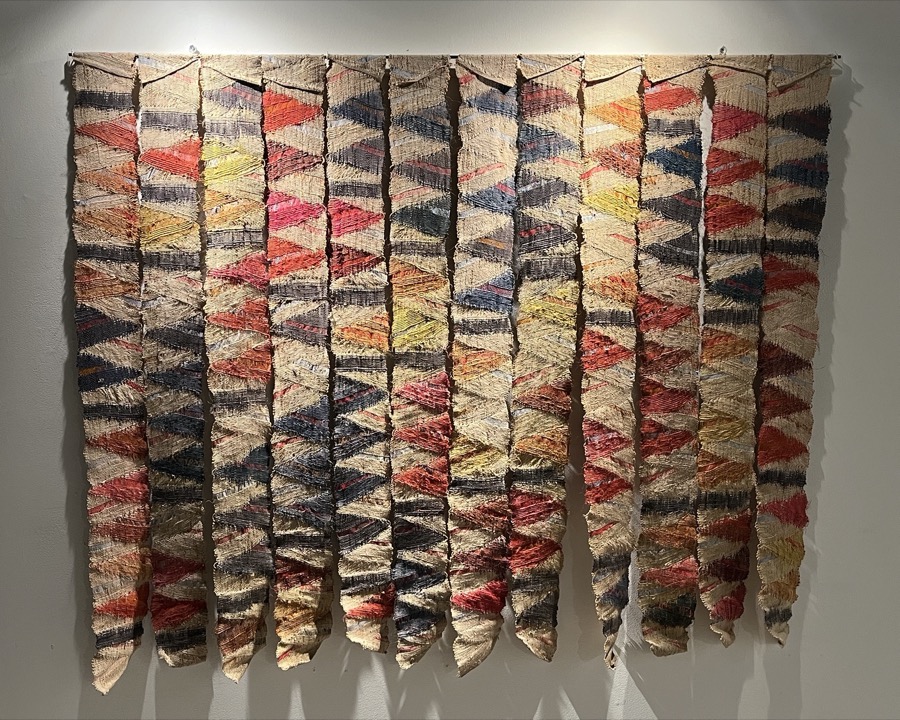
Wedge Weave #4
1983
Silk, sisal, linen, cotton
Courtesy of the Artist and Elena Phipps
James Bassler
Wedge Weave #3
1983
Silk, sisal, linen, cotton
Courtesy of the Artist and Elena Phipps
Weshoyot Alvitre
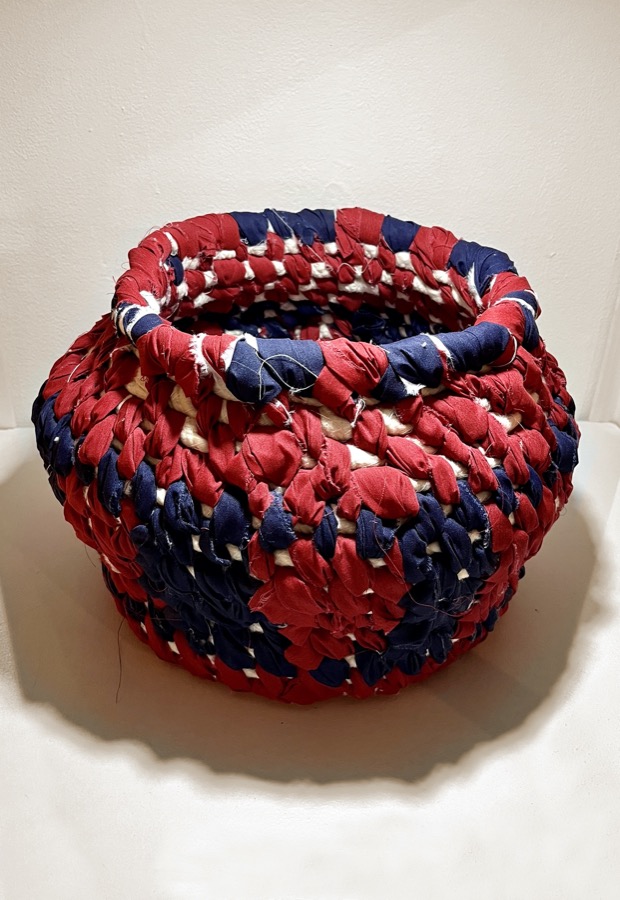
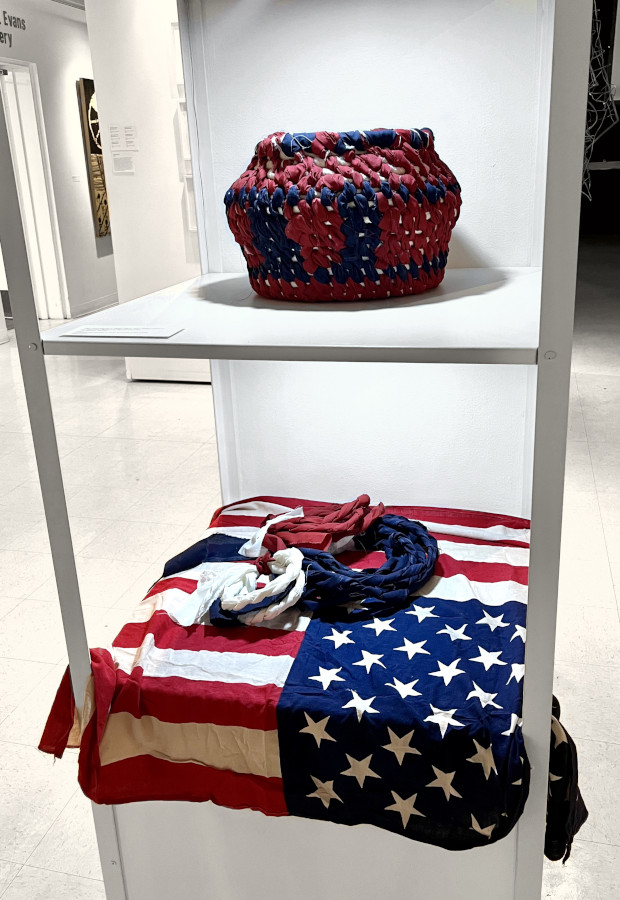
Our Sovereignty is Older Than Your Independence:
A Funerary Basket of Deconstruction
2026
Torn patriotic bunting in cotton and dyed cotton, cotton foundation
This basket is woven in traditional coil style of my tribe (Tongva-Gabrielino), and other Southern California Tribal peoples, out of hand torn patriotic bunting fabric. The foundation is raw cotton. It was intentionally woven made in the style and form of our baskets made specifically for funerary ceremony. Historically our baskets are made of deergrass, sumac and juncus (natural and dyed). Due to colonization and it’s many affects on land health, plant health of basket plant materials, traditional knowledge of manufacture, etc. we often do not have access to our homelands to gather materials or access to healthy places not polluted or impacted by urban development to safely gather materials. In 2026 America celebrates 250 years since its Declaration of Independence: a document that lists Native people as “Merciless Indian Savages” as well as extracts from the pre-existing verbiage and iconography of political organization of the Iroquois Confederacy. Native American tribes each had their own governance, politics and Nation to Nation structure for thousands of years prior to the occupation by Mexico or the United States of America. Our Sovereignty is Older than the Independence of the Nation founded over our homelands.
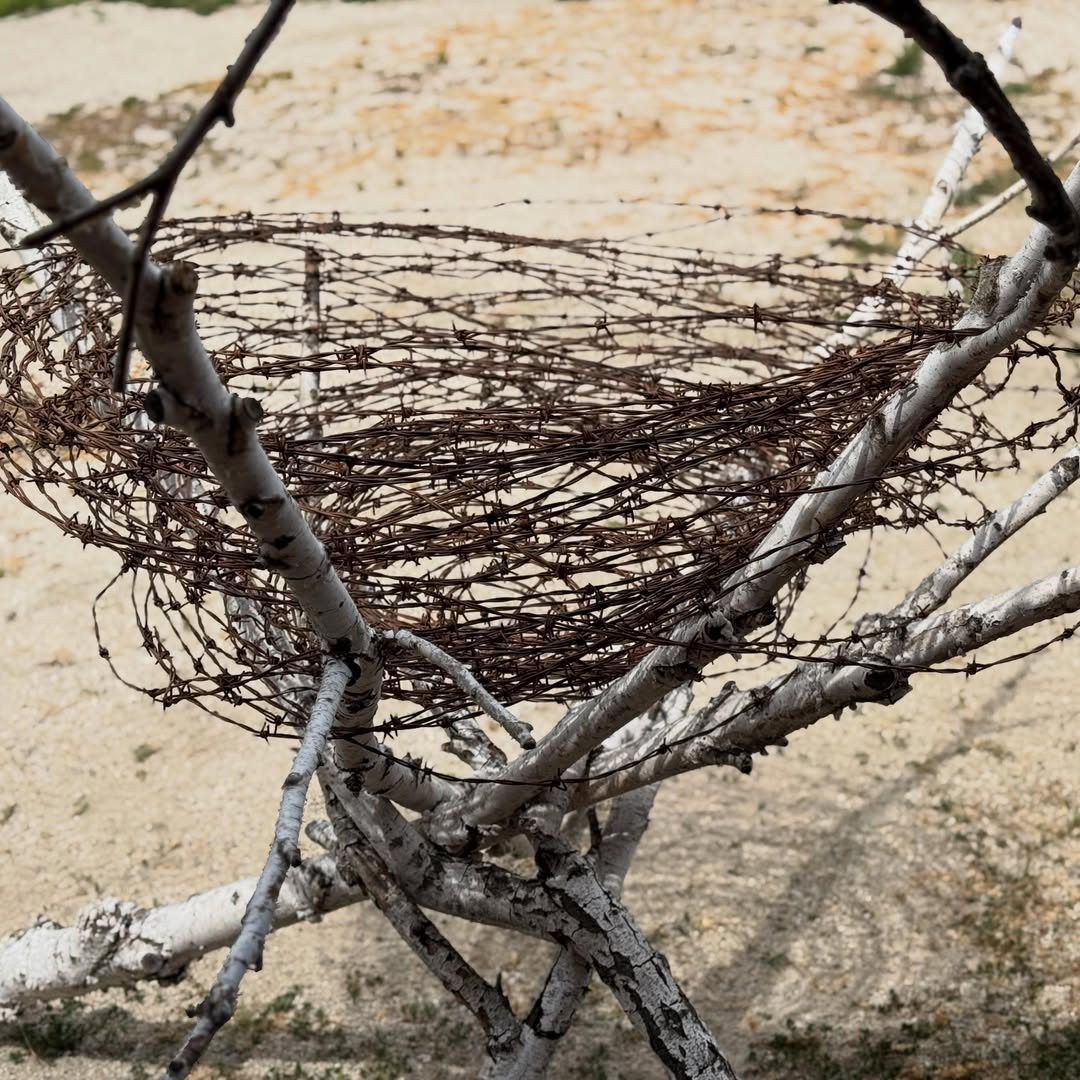
Cyrena Nouzille
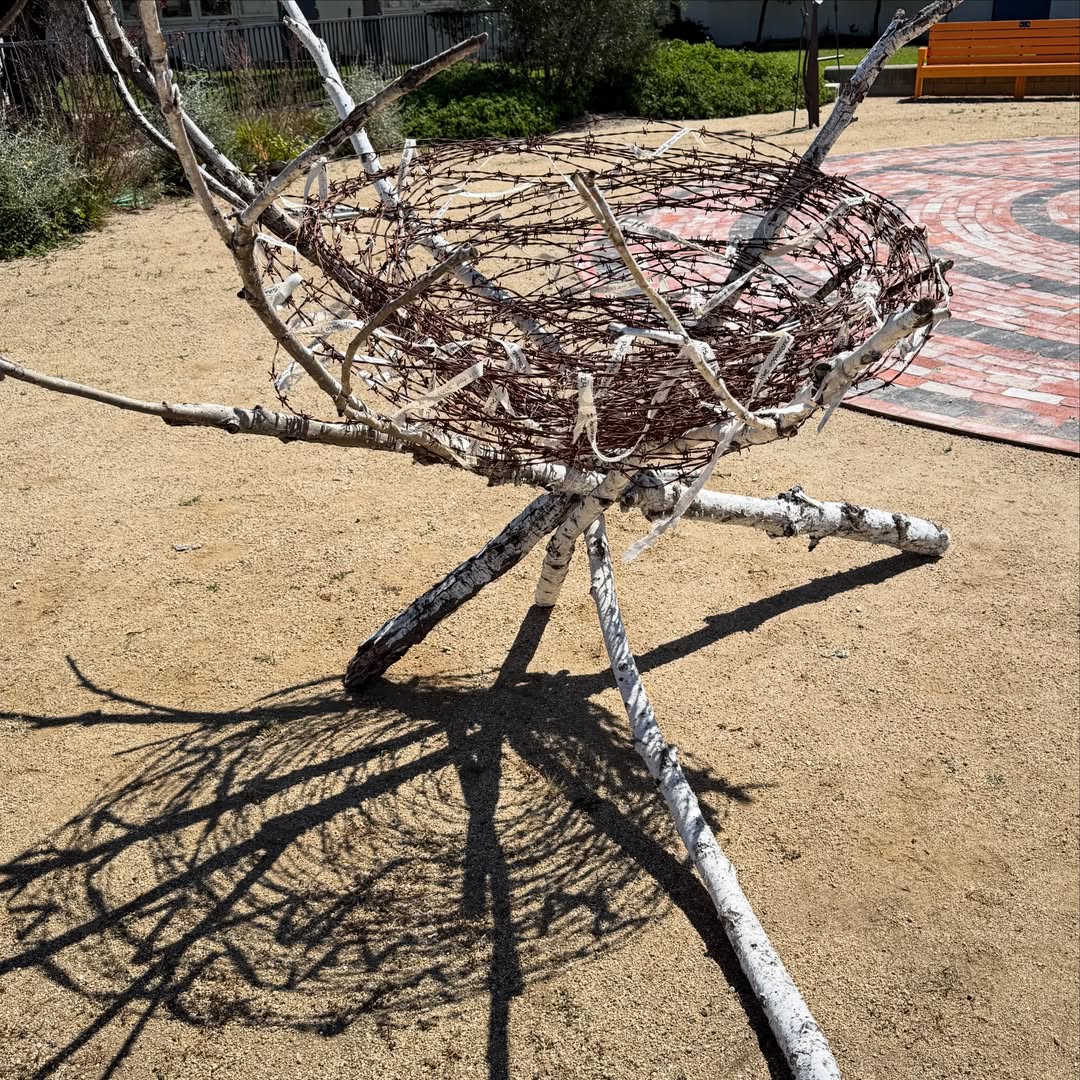
U.S. Patent No.157124
April 2026
Birch branches, rusty barbed wire, canvas, and ink
Installed in the Roxie Ray Sculpture Garden
Barbed wire was first patented in the United States and spread rapidly after Joseph Glidden’s 1874 improvements and manufacturing method made it practical to produce and use at scale. It was invented to solve a specific problem on the Great Plains, where pioneering farmers and ranchers needed a cheap way to fence land, mark private boundaries, and contain livestock. It did more than manage animals. I keep coming back to the fact that the wire was never only a material; from the beginning, it was a tool for turning open space into claimed space, and defined how the West was “won.” Barbed wire helped bring an end to the open range, shifted power toward those who could fence land, and further constricted Native American movement through places that had long been used in common. Later, the same material moved from pasture to warfare; it was used as a military barrier and trap, and became synonymous with incarceration camps during World War II.
A nest is one of the first architectures of care, an incubator of genetic cultivation. It is built from what is readily at hand, held together by repetition, instinct, and need. From a distance, the nest offers the familiar promise of shelter and with it, protection. Oversized, this nest meets the body at human scale, but not with an image of comfort and innocence, and carries the pressure of the world around it. I wanted the barbed wire to speak to the way human beings build systems and structures to protect what they love, and how quickly those same systems begin to exclude, divide, and injure. I am interested in home as a fantasy of safety, and as something fragile, negotiated, and political. The sculpture resides in that contradiction. It asks what kind of home we make when fear and misunderstanding are the building materials, and whether protection becomes indistinguishable from aggression.
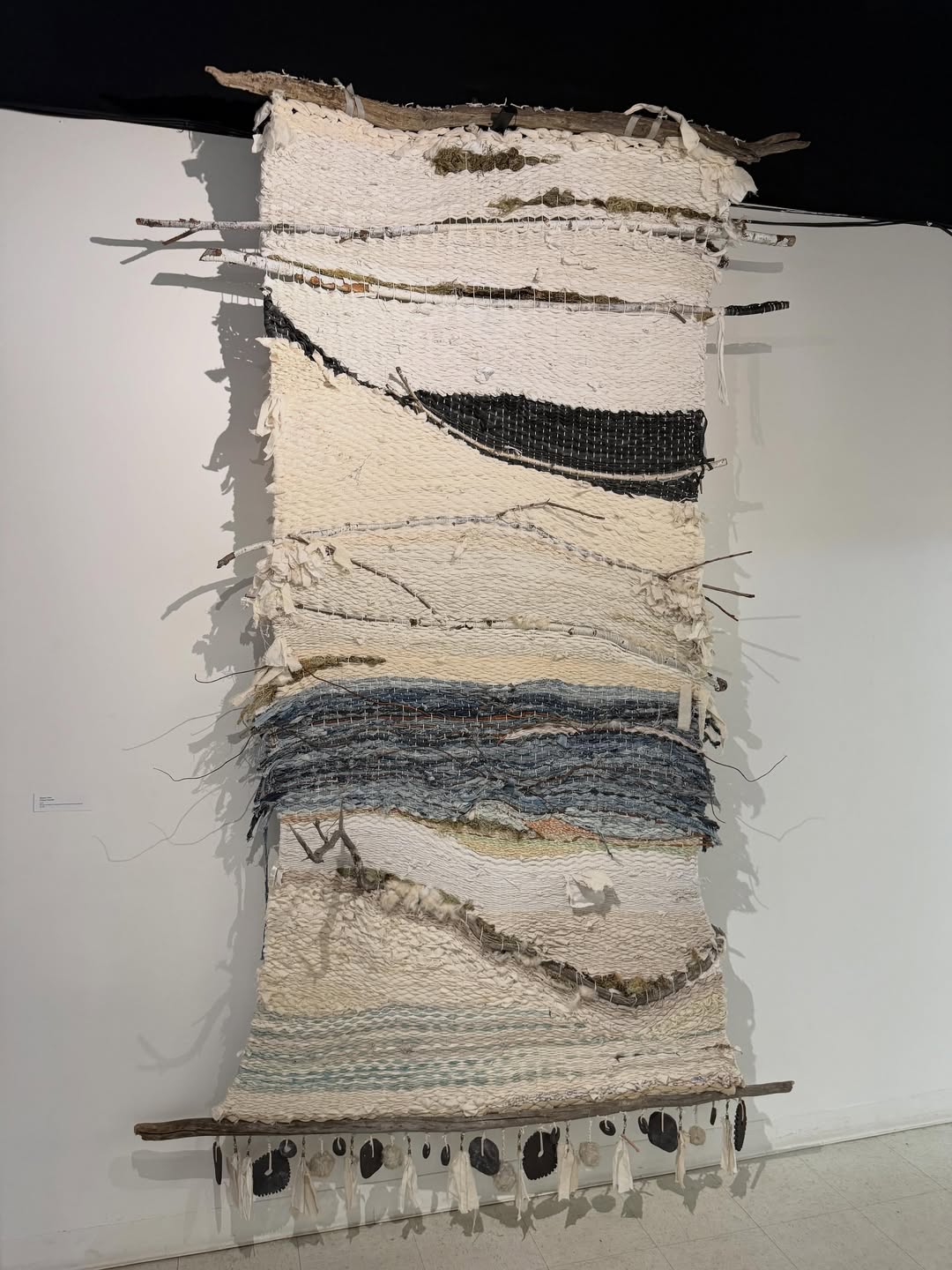
Cyrena Nouzille
Human Time
2026
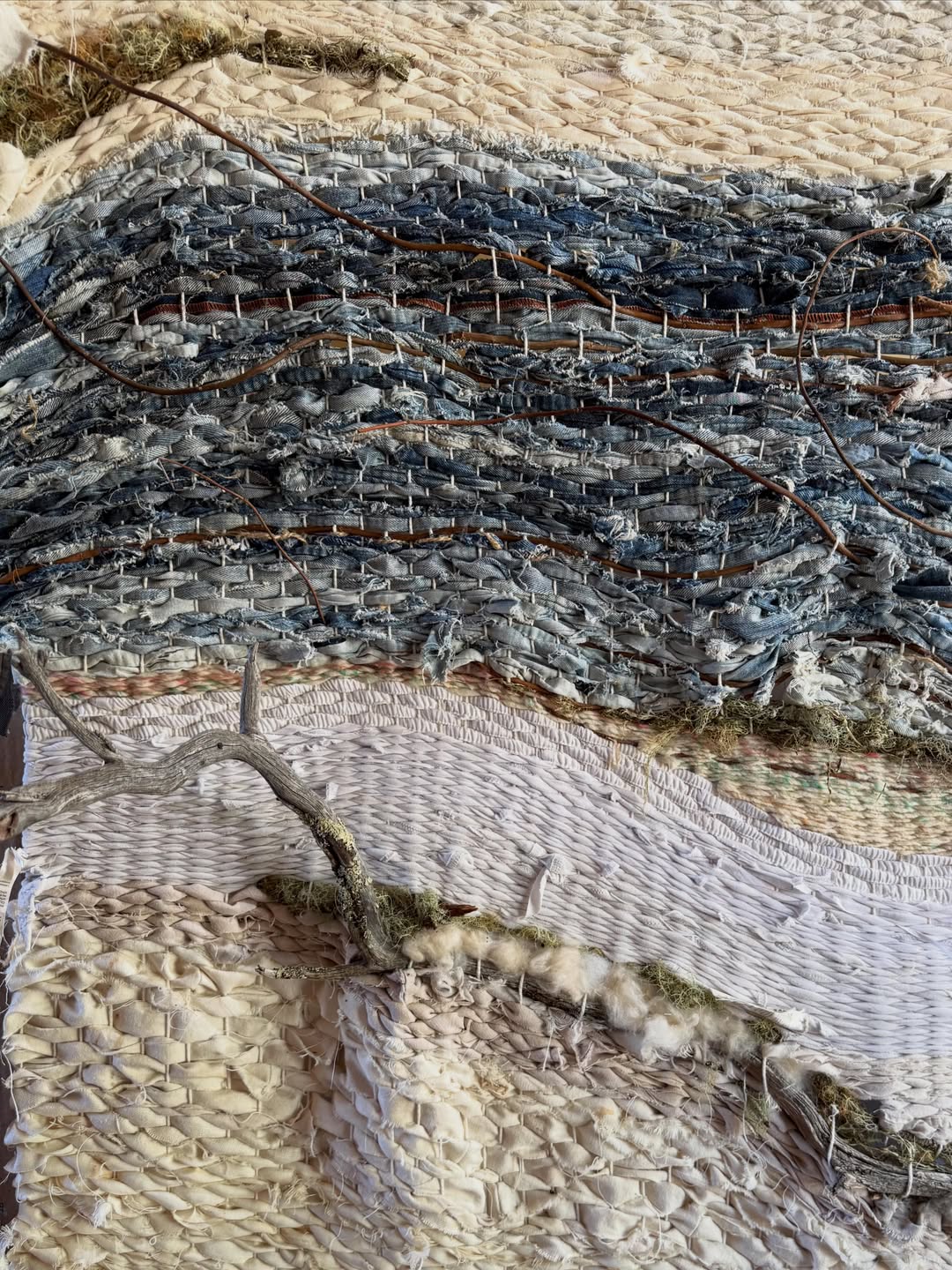
Woven remnants of repurposed textiles and natural materials
Scientists study time through the geologic layers identified by event markers and the remnants of organisms that dwell in them. What will our time on this planet look like, captured in its layers? From a global perspective, we may begin to identify a marker for a new geologic epoch — the proposed but still-debated Anthropocene — a layer in time defined by our making, inventions, cumulative pollution, and changes to Earth’s environment. Will human geomorphic impacts leave a new type of footprint layered in future ice or sediment records, like discarded fabric fossils woven into the planet’s surface?
Michelle Robinson
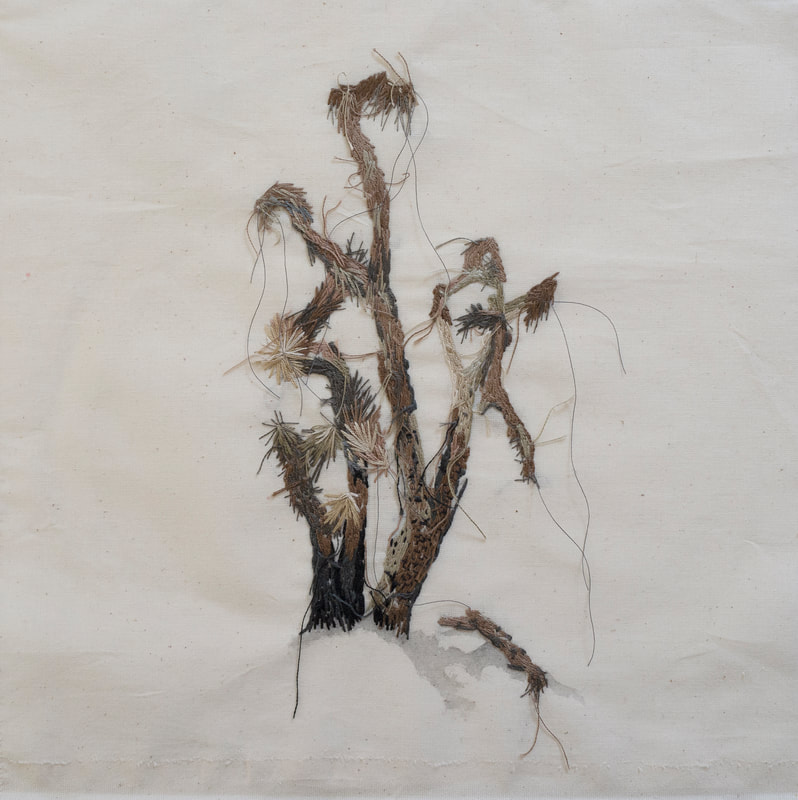
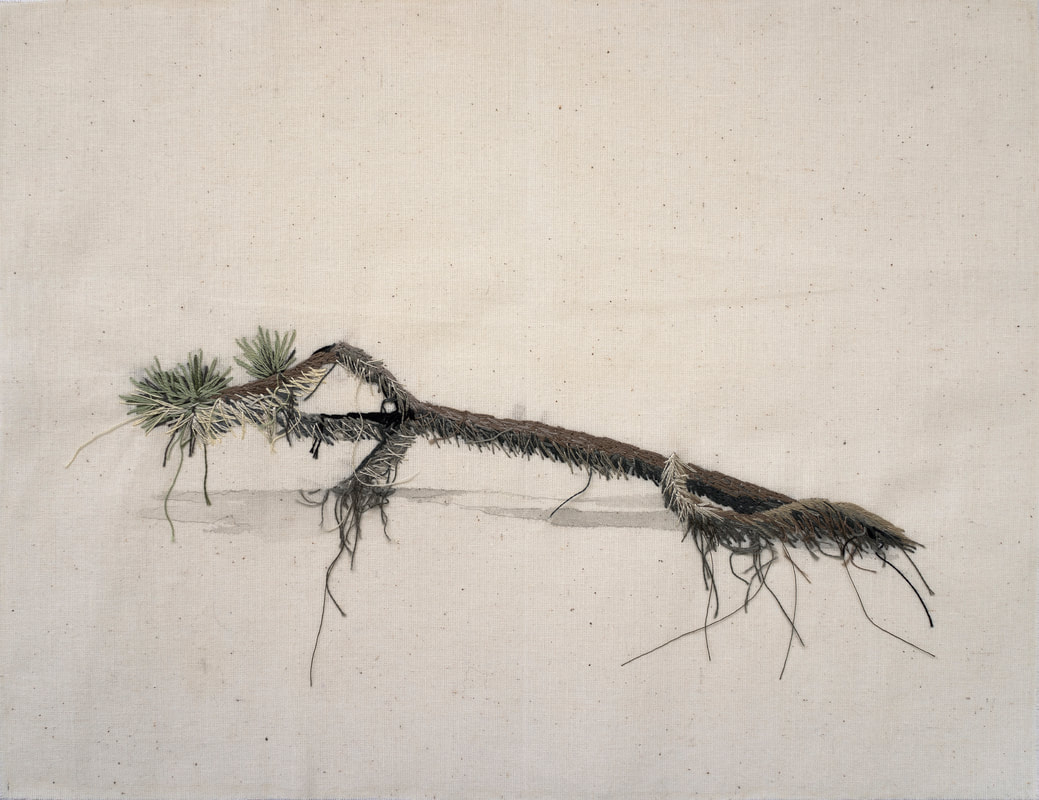
Mourning 5
2023
Cotton embroidery on unbleached muslin
Ghosts
At a recent residency in Joshua Tree, I investigated the slow violence happening to Joshua trees through climate change. Joshua trees are intricately dependent on other specialized beings to pollinate their flowers, disperse their seeds, and nurse their seedlings. As the links in this chain fail, the trees are increasingly imperiled. Recent research suggests that, without intervention, habitat loss for the trees within Joshua Tree National Park could exceed 99%. Knowing this has motivated me to make that future absence visibly present in the landscape. As I spent time among them, I saw that the trees would curl in on themselves when they became stressed and started to die, which I found incredibly poignant. My embroidered portraits, which reference 19th-century mourning pictures, are visual elegies to these singular beings and their struggle to survive increasingly hostile conditions.
Michelle Robinson
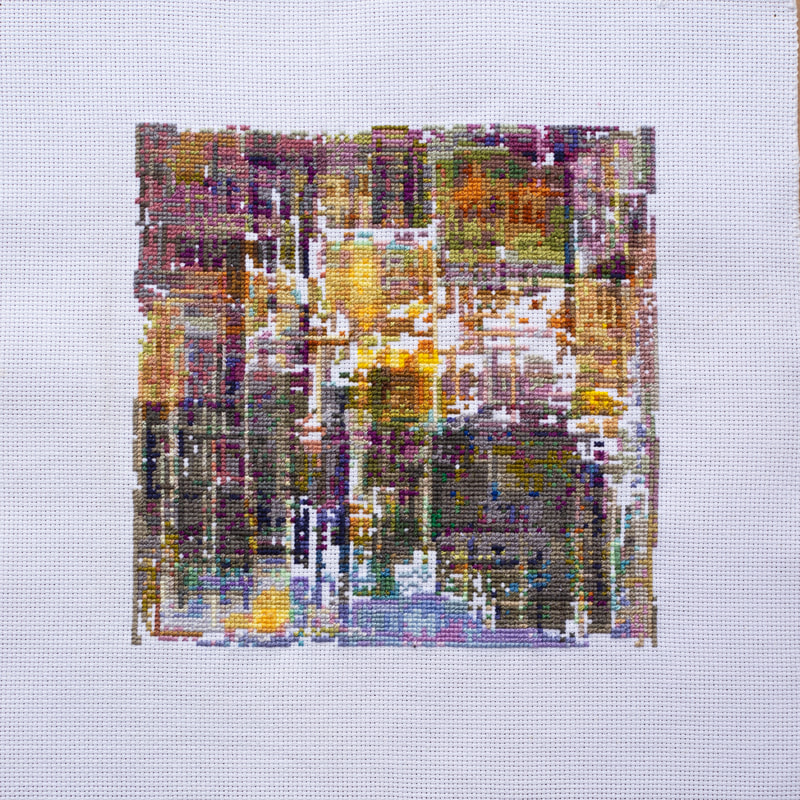
Mourning 4
2023
Cotton embroidery on unbleached muslin
Ghosts
At a recent residency in Joshua Tree, I investigated the slow violence happening to Joshua trees through climate change. Joshua trees are intricately dependent on other specialized beings to pollinate their flowers, disperse their seeds, and nurse their seedlings. As the links in this chain fail, the trees are increasingly imperiled. Recent research suggests that, without intervention, habitat loss for the trees within Joshua Tree National Park could exceed 99%. Knowing this has motivated me to make that future absence visibly present in the landscape. As I spent time among them, I saw that the trees would curl in on themselves when they became stressed and started to die, which I found incredibly poignant. My embroidered portraits, which reference 19th-century mourning pictures, are visual elegies to these singular beings and their struggle to survive increasingly hostile conditions.
Michelle Robinson
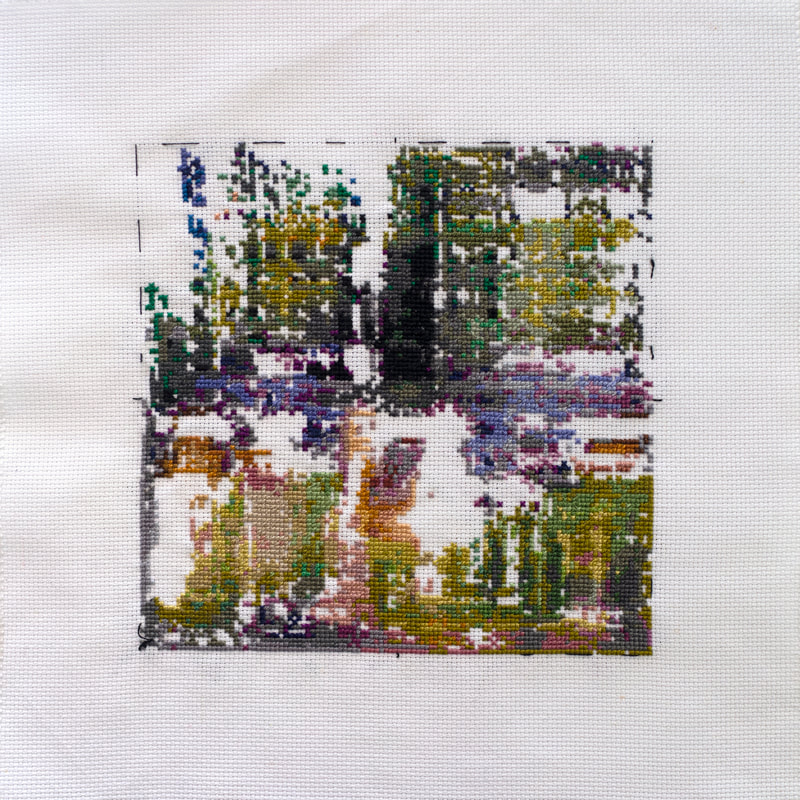
Valley House 50.004
2021
Cotton cross stitch on 18 pt Aida
No Place
The project No Place is a meditation on the frangibility of memory of home. I trained a naive Generative Adversarial Network AI using a data set composed solely of my own photographs of suburban neighborhoods I have lived in. I pulled several stills from the AI’s evolutionary sequences, which started with an undifferentiated wall of pixels and ended with something nearly recognizable as a house. I then transposed these uncanny images by hand into small cross-stitched pieces and embroideries, using stitching as an analog equivalent to the pixel. Through repeated acts of tender translation between myself and the AI, between digital generation and painstaking analog labor, I am generating a feedback loop that both loses and gains information along the way. The glitchiness of my memory is reflected back at me as I make and remake my childhood home.
Michelle Robinson
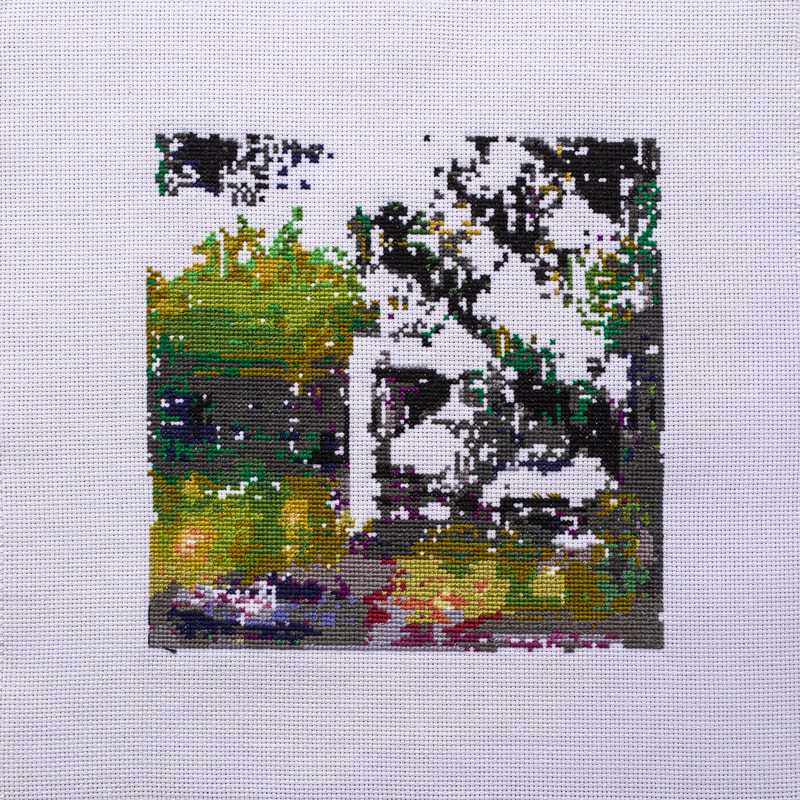
Valley House 50.010
2022
Cotton cross stitch on 18 pt Aida
No Place
The project No Place is a meditation on the frangibility of memory of home. I trained a naive Generative Adversarial Network AI using a data set composed solely of my own photographs of suburban neighborhoods I have lived in. I pulled several stills from the AI’s evolutionary sequences, which started with an undifferentiated wall of pixels and ended with something nearly recognizable as a house. I then transposed these uncanny images by hand into small cross-stitched pieces and embroideries, using stitching as an analog equivalent to the pixel. Through repeated acts of tender translation between myself and the AI, between digital generation and painstaking analog labor, I am generating a feedback loop that both loses and gains information along the way. The glitchiness of my memory is reflected back at me as I make and remake my childhood home.
Michelle Robinson
Valley House 50.016
2022
Cotton cross stitch on 18 pt Aida
No Place
The project No Place is a meditation on the frangibility of memory of home. I trained a naive Generative Adversarial Network AI using a data set composed solely of my own photographs of suburban neighborhoods I have lived in. I pulled several stills from the AI’s evolutionary sequences, which started with an undifferentiated wall of pixels and ended with something nearly recognizable as a house. I then transposed these uncanny images by hand into small cross-stitched pieces and embroideries, using stitching as an analog equivalent to the pixel. Through repeated acts of tender translation between myself and the AI, between digital generation and painstaking analog labor, I am generating a feedback loop that both loses and gains information along the way. The glitchiness of my memory is reflected back at me as I make and remake my childhood home.
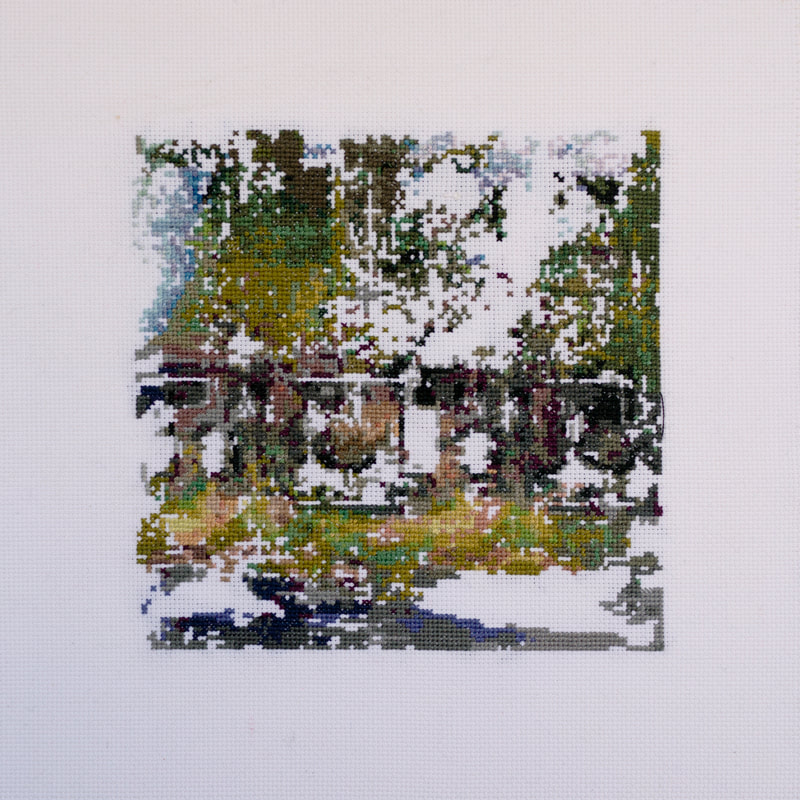
Michelle Robinson
Valley House 50.024
2024
Cotton cross stitch on 18 pt Aida
No Place
The project No Place is a meditation on the frangibility of memory of home. I trained a naive Generative Adversarial Network AI using a data set composed solely of my own photographs of suburban neighborhoods I have lived in. I pulled several stills from the AI’s evolutionary sequences, which started with an undifferentiated wall of pixels and ended with something nearly recognizable as a house. I then transposed these uncanny images by hand into small cross-stitched pieces and embroideries, using stitching as an analog equivalent to the pixel. Through repeated acts of tender translation between myself and the AI, between digital generation and painstaking analog labor, I am generating a feedback loop that both loses and gains information along the way. The glitchiness of my memory is reflected back at me as I make and remake my childhood home.
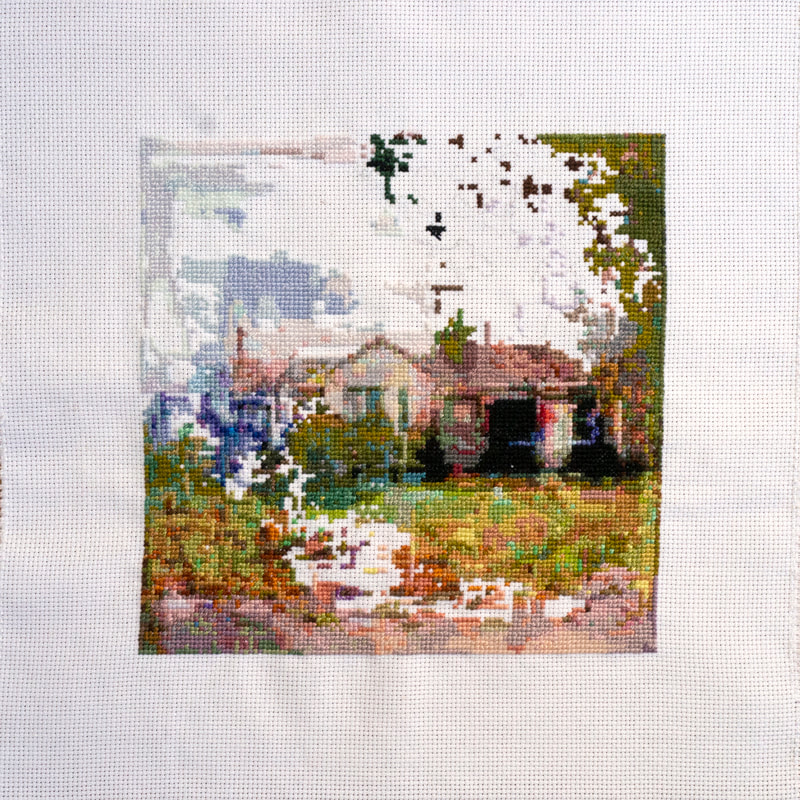
Michelle Robinson
Valley House 50.140
2021
Cotton cross stitch on 18 pt Aida
No Place
The project No Place is a meditation on the frangibility of memory of home. I trained a naive Generative Adversarial Network AI using a data set composed solely of my own photographs of suburban neighborhoods I have lived in. I pulled several stills from the AI’s evolutionary sequences, which started with an undifferentiated wall of pixels and ended with something nearly recognizable as a house. I then transposed these uncanny images by hand into small cross-stitched pieces and embroideries, using stitching as an analog equivalent to the pixel. Through repeated acts of tender translation between myself and the AI, between digital generation and painstaking analog labor, I am generating a feedback loop that both loses and gains information along the way. The glitchiness of my memory is reflected back at me as I make and remake my childhood home.
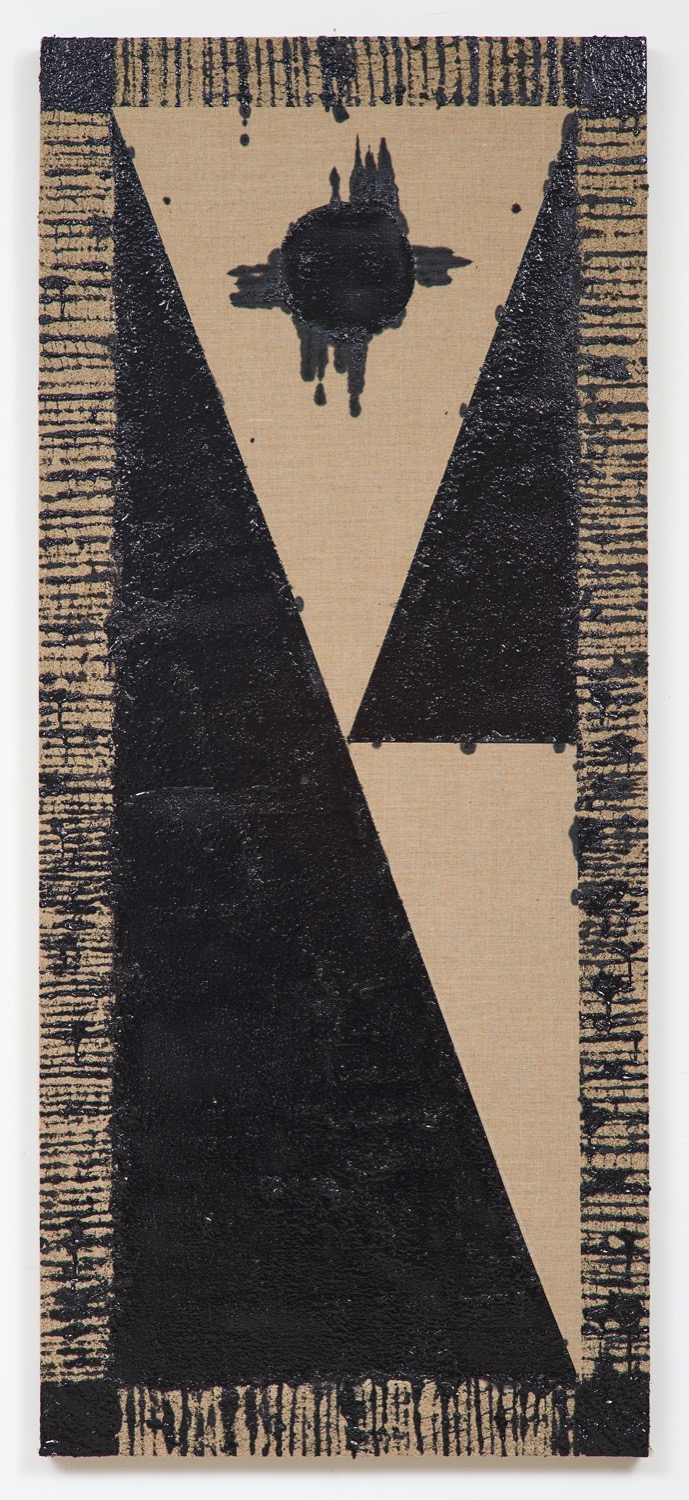
Lorenzo Hurtado Segovia
Untitled 2
2017
Sand and tar on linen over panel
Tar and sand paintings
These works, made with materials sourced from the LA region’s natural environment, embody and signify location and cultural synchretization through time in the area.
Tar from the La Brea Tar Pits and Sand from the Playa Del Rey beach in Southern California are physical products of millenary natural processes. Though not readily seen to the human eye, these materials can be dated and traced to this particular location by scientific methods and are beyond human scales of time.
The imagery is a hybrid of overlapped world views and cosmologies between “old” and “new” worlds. For example, a fish icon is of spiritual significance to both Judeo-Christian and Pacific Coast Indigenous peoples. Similarly, observing and recording bodies in the sky served to track time, navigation, and as metaphors for their beliefs.
My artwork is rooted in craft traditions informed by Judeo-Christian and Indigenous theology, art history, and ethnographic motifs. Their materials and processes are varied and inspired by textiles, world crafts, painting, embroidery, weaving, and carpentry. The resulting aesthetic is an intricate and multi-layered synthesis of figuration, abstraction, and decoration. The meanings that unfold are emotional, social, philosophical, and personal. My hope and vision are to bring Christian themes into the contemporary art world as a relevant subject of discourse. I am inspired by how various peoples interpret beliefs and in the many ways they are represented through ritual and artifact.
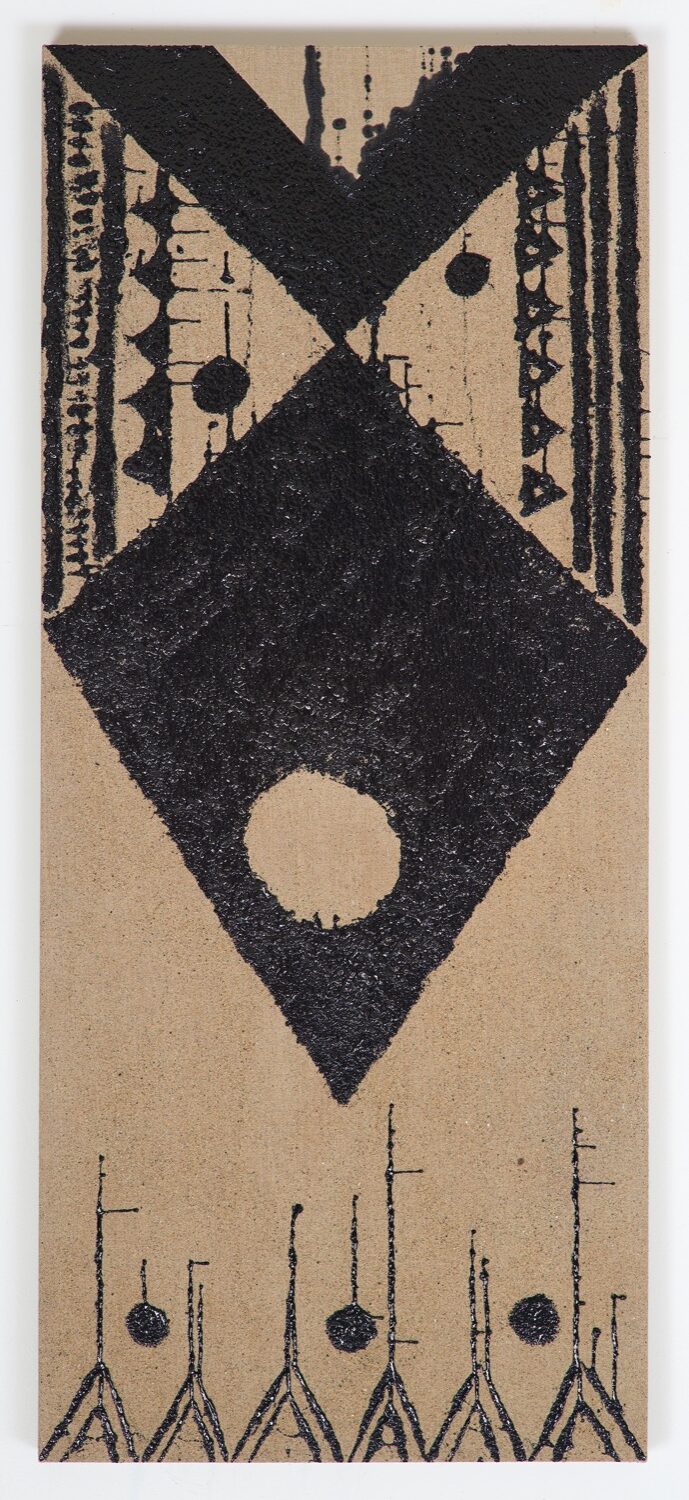
Lorenzo Hurtado Segovia
Untitled (6)
2017
Sand and tar on linen over panel
Tar and sand paintings
These works, made with materials sourced from the LA region’s natural environment, embody and signify location and cultural synchretization through time in the area.
Tar from the La Brea Tar Pits and Sand from the Playa Del Rey beach in Southern California are physical products of millenary natural processes. Though not readily seen to the human eye, these materials can be dated and traced to this particular location by scientific methods and are beyond human scales of time.
The imagery is a hybrid of overlapped world views and cosmologies between “old” and “new” worlds. For example, a fish icon is of spiritual significance to both Judeo-Christian and Pacific Coast Indigenous peoples. Similarly, observing and recording bodies in the sky served to track time, navigation, and as metaphors for their beliefs.
My artwork is rooted in craft traditions informed by Judeo-Christian and Indigenous theology, art history, and ethnographic motifs. Their materials and processes are varied and inspired by textiles, world crafts, painting, embroidery, weaving, and carpentry. The resulting aesthetic is an intricate and multi-layered synthesis of figuration, abstraction, and decoration. The meanings that unfold are emotional, social, philosophical, and personal. My hope and vision are to bring Christian themes into the contemporary art world as a relevant subject of discourse. I am inspired by how various peoples interpret beliefs and in the many ways they are represented through ritual and artifact.
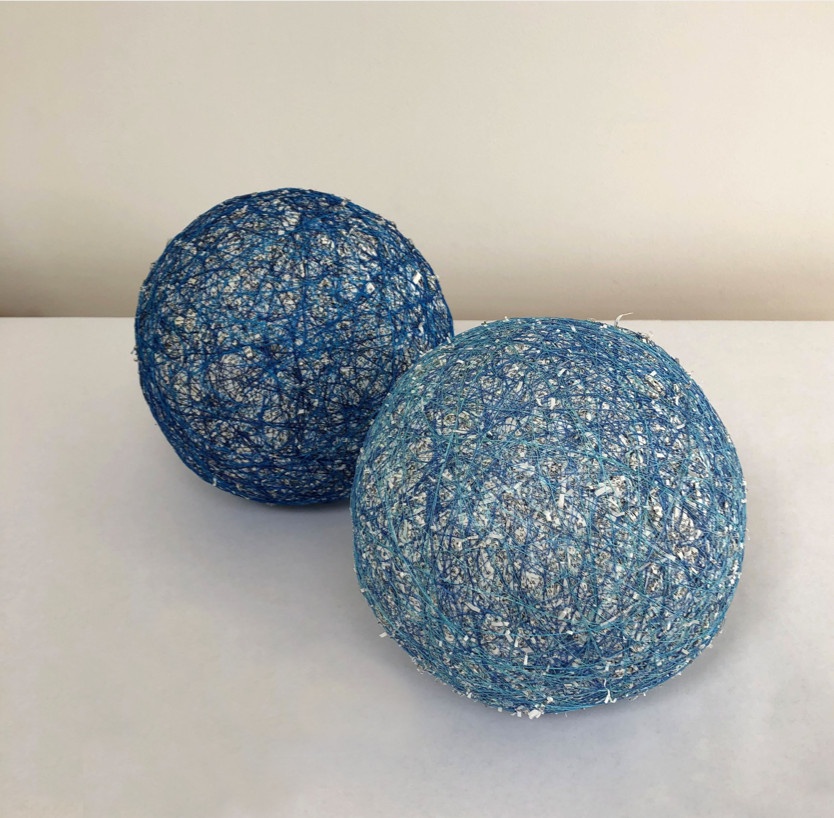
Linda Ekstrom
Thread: Day Sky & Thread: Night Sky
Altered Bible, thread
The Bible pages are shredded and formed into balls tightly wound with thread to suggest the microcosm of a ball of yarn or the macrocosm of a planet.
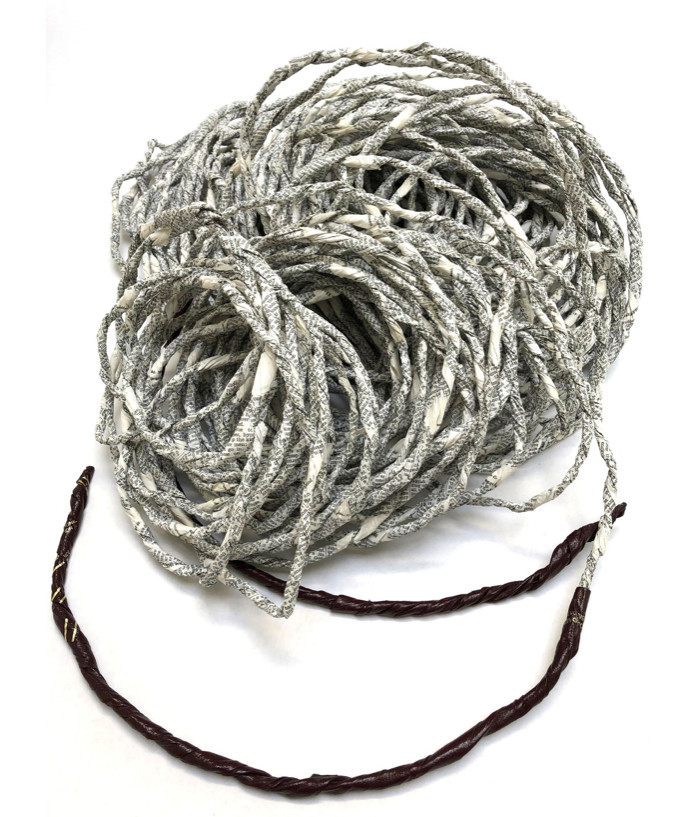
Linda Ekstrom
Tangled
2005
Twined Bible, leather strap
The words of the Bible have been interpreted and reinterpreted by male consensus for centuries. The artist has twined the pages into a long continuous line that disrupts a literal reading. In this display, the text coils around onto itself to form a hive, or womb-like shape.
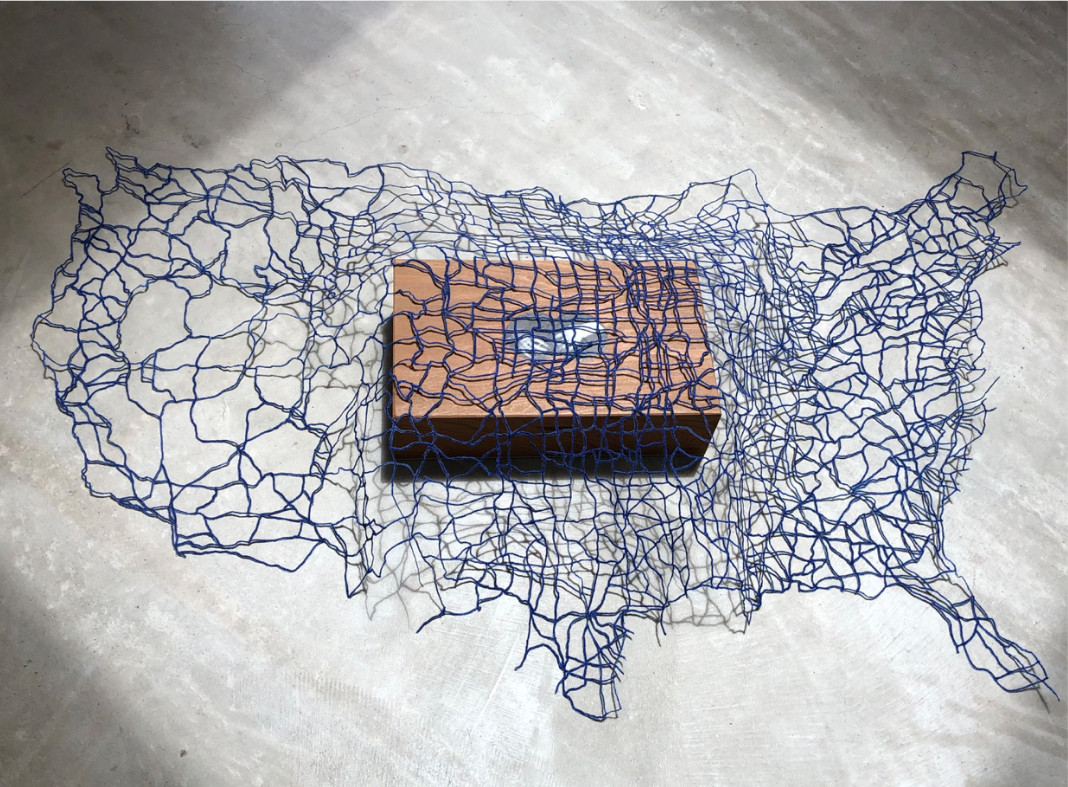
Linda Ekstrom
Day is Done
2006
Thread, wood box, photo image
The sewn map follows a map of the major highways in the US. The land masses are then cut away to leave a skeletal structure of thread, like domestic lace.
The map rests over a reliquary box as an expression of the loss experienced from war and violence.
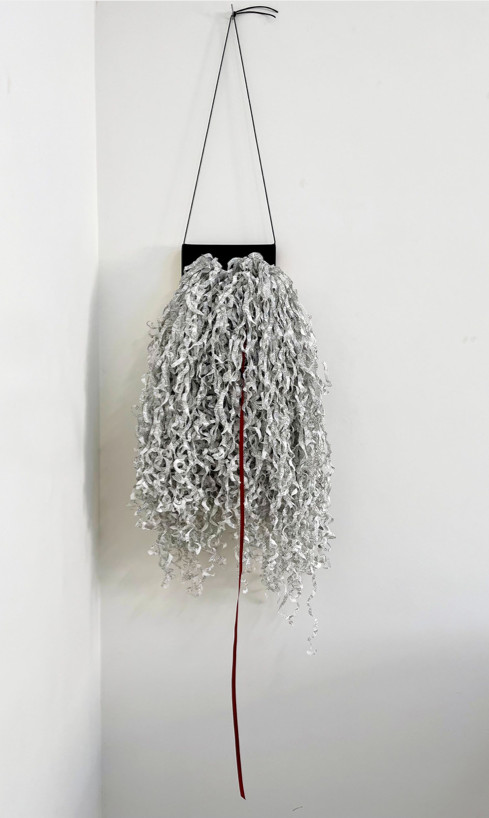
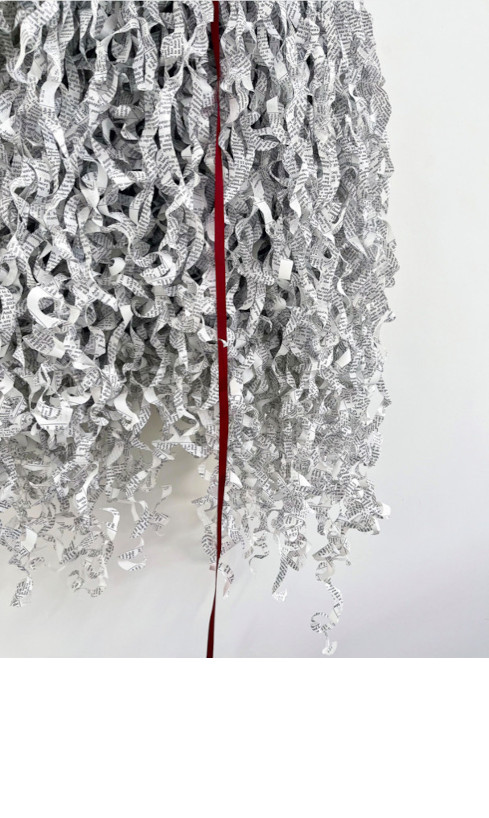
Linda Ekstrom
Effusive
2023
Altered bible, ribbon, leather strap
Each page is cut into spirals to allow the text to unfurl from the confines of the book and spill out into the world. The tangle suggests the sensuousness of women’s hair. This makes reference to the many stories in the Bible that justify ways to circumscribe women, specifically the female body.
Lorenzo Hurtado Segovia
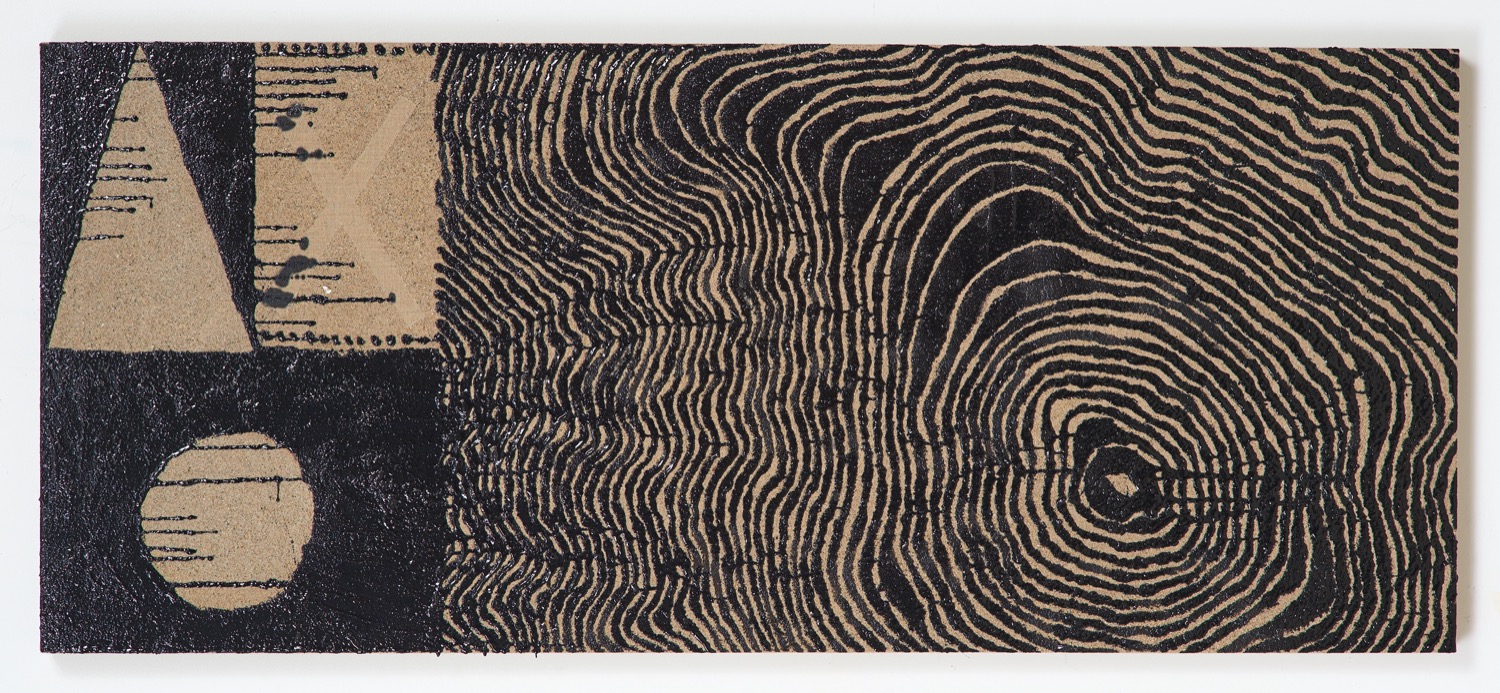
Untitled (7)
2017
Sand and tar on linen over panel
Tar and sand paintings
These works, made with materials sourced from the LA region’s natural environment, embody and signify location and cultural synchretization through time in the area.
Tar from the La Brea Tar Pits and Sand from the Playa Del Rey beach in Southern California are physical products of millenary natural processes. Though not readily seen to the human eye, these materials can be dated and traced to this particular location by scientific methods and are beyond human scales of time.
The imagery is a hybrid of overlapped world views and cosmologies between “old” and “new” worlds. For example, a fish icon is of spiritual significance to both Judeo-Christian and Pacific Coast Indigenous peoples. Similarly, observing and recording bodies in the sky served to track time, navigation, and as metaphors for their beliefs.
My artwork is rooted in craft traditions informed by Judeo-Christian and Indigenous theology, art history, and ethnographic motifs. Their materials and processes are varied and inspired by textiles, world crafts, painting, embroidery, weaving, and carpentry. The resulting aesthetic is an intricate and multi-layered synthesis of figuration, abstraction, and decoration. The meanings that unfold are emotional, social, philosophical, and personal. My hope and vision are to bring Christian themes into the contemporary art world as a relevant subject of discourse. I am inspired by how various peoples interpret beliefs and in the many ways they are represented through ritual and artifact.
Lorenzo Hurtado Segovia
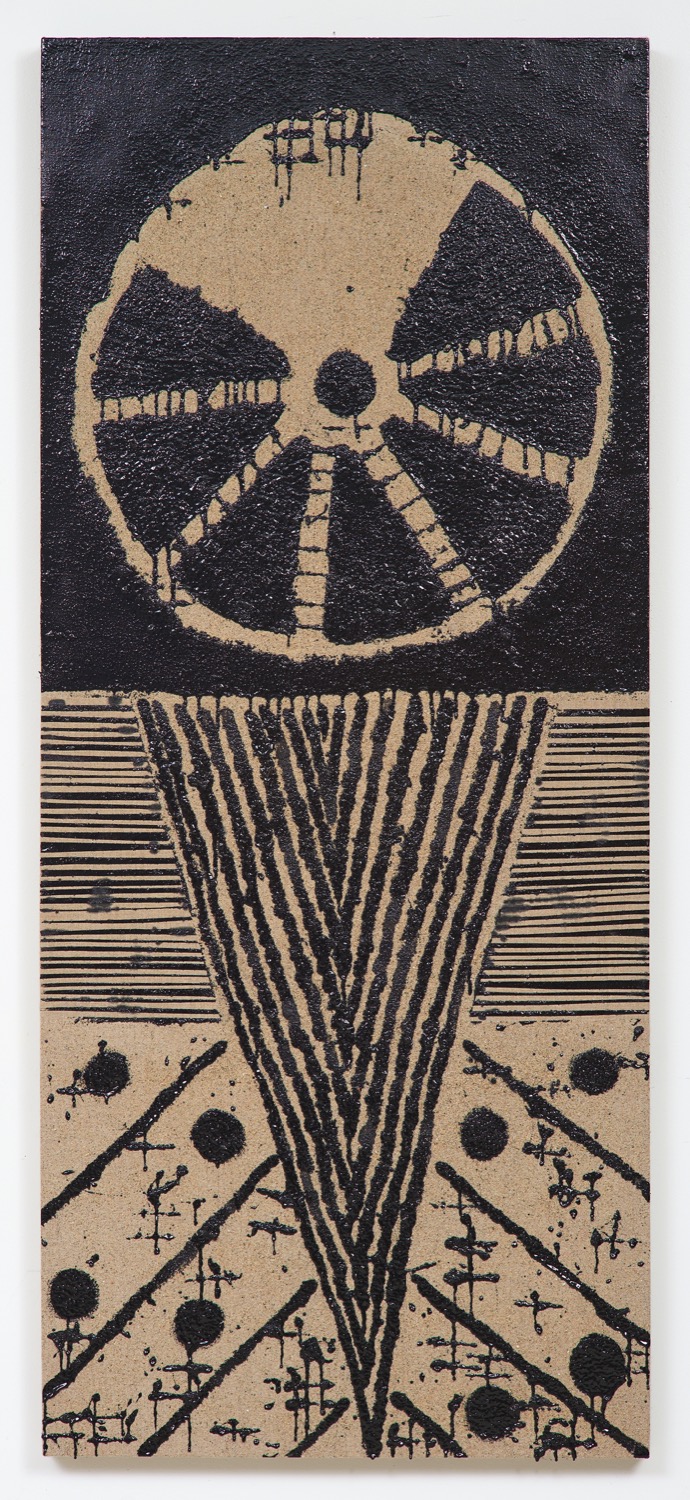
Untitled (5)
2017
Sand and tar on linen over panel
Tar and sand paintings
These works, made with materials sourced from the LA region’s natural environment, embody and signify location and cultural synchretization through time in the area.
Tar from the La Brea Tar Pits and Sand from the Playa Del Rey beach in Southern California are physical products of millenary natural processes. Though not readily seen to the human eye, these materials can be dated and traced to this particular location by scientific methods and are beyond human scales of time.
The imagery is a hybrid of overlapped world views and cosmologies between “old” and “new” worlds. For example, a fish icon is of spiritual significance to both Judeo-Christian and Pacific Coast Indigenous peoples. Similarly, observing and recording bodies in the sky served to track time, navigation, and as metaphors for their beliefs.
My artwork is rooted in craft traditions informed by Judeo-Christian and Indigenous theology, art history, and ethnographic motifs. Their materials and processes are varied and inspired by textiles, world crafts, painting, embroidery, weaving, and carpentry. The resulting aesthetic is an intricate and multi-layered synthesis of figuration, abstraction, and decoration. The meanings that unfold are emotional, social, philosophical, and personal. My hope and vision are to bring Christian themes into the contemporary art world as a relevant subject of discourse. I am inspired by how various peoples interpret beliefs and in the many ways they are represented through ritual and artifact.
Michael F. Rohde
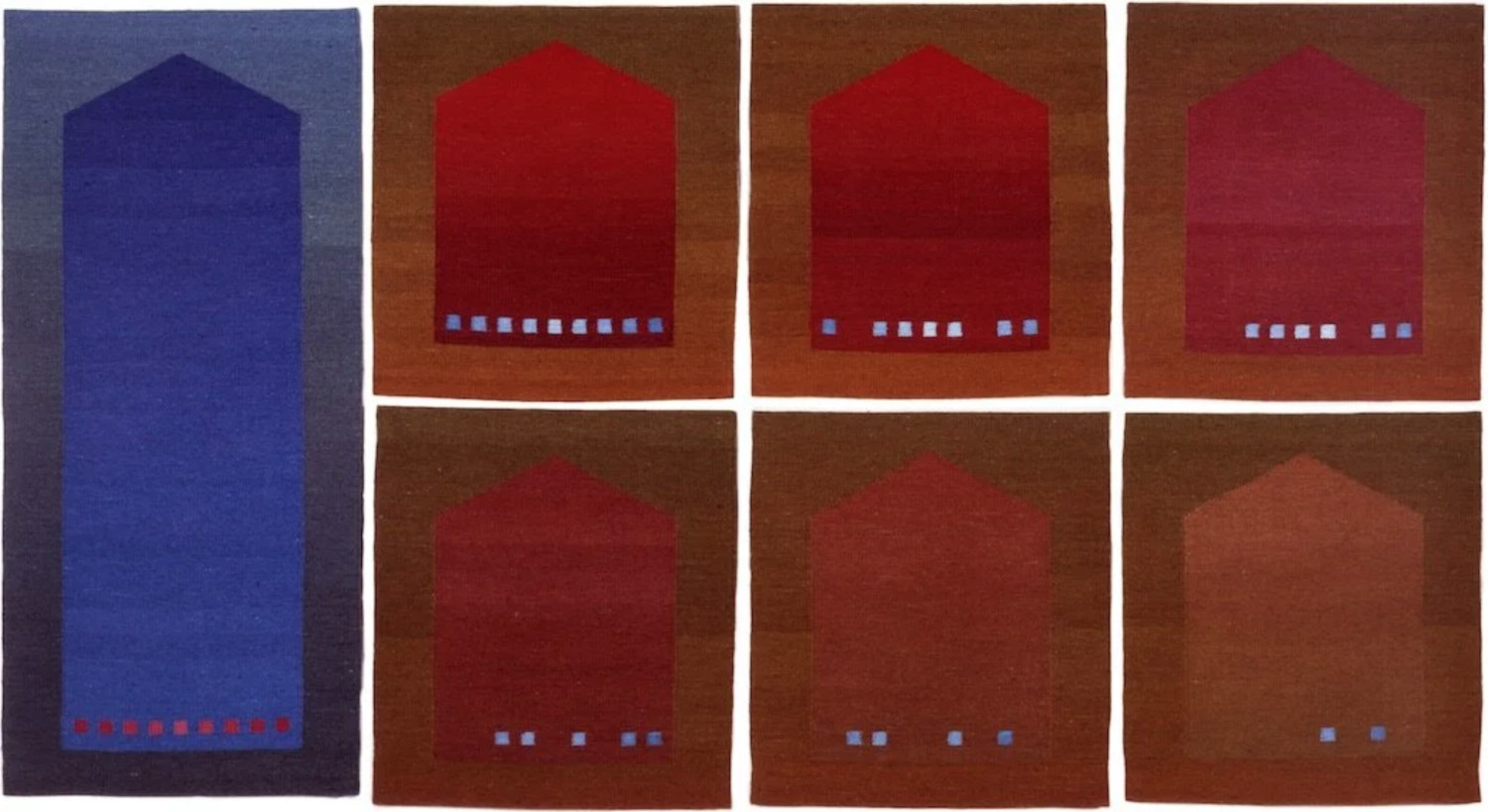
From My House to Your Homeland
2003
Handwoven tapestry: wool, silk, dyes
Woven in 2003, this was a pivotal work for me, in that it was a transition from geometric designs as the starting point. This tapestry, and most of my subsequent work, started with ideas or concepts. This was the year when it was decided to invade Iraq again. The title comes from a poem by June Jordan, lamenting the damages, loss of lives and property in wars – a lesson not learned.
“And this is for the victims of the bombing of Baghdad
because the enemy traveled from my house
to blast your homeland
into pieces of children
and pieces of sand”
—June Jordon, from “Kissing God Goodbye, Poems: 1991-1997”
The medium in which I choose to work is fiber, primarily flat woven pieces. I’ve picked this less than common medium, having been drawn to the possibilities of relationships between subliminal texture and the interaction of light and color.
Having taken this route, the weavings can become an embodiment of the freedom to explore how colors relate to each other and to the surface properties of the fibers used. Pure color and specific color combinations of color have the power to speak to each of us, often producing differing responses in each person. By limiting the vocabulary to color and woven texture, the works are better able to stimulate reactions and emotions that these raw color and spatial relationships can have on the viewer.
Recent pieces of work over the last several years have addressed the impact of human and natural causes on the homes and lives of people. These include houses that disappear into the sands of war, are filled with rising flood waters or simply vanish as the natural consequence of time. One set of recent work is a group of tapestry woven pixelated faces, touching on abstraction and reality at the same time. Most recent is a set of large scale “Imagined Language” tapestries.
Yet, without the foreknowledge of what is behind the creation of these images, the works stand as objects of quiet beauty: begun with white yarns of wool, silk, linen and other fibers, I add my own dyes to achieve a range colors and contrast not available in commercially dyed materials. Like a painter, I mix my own colors to create something new.
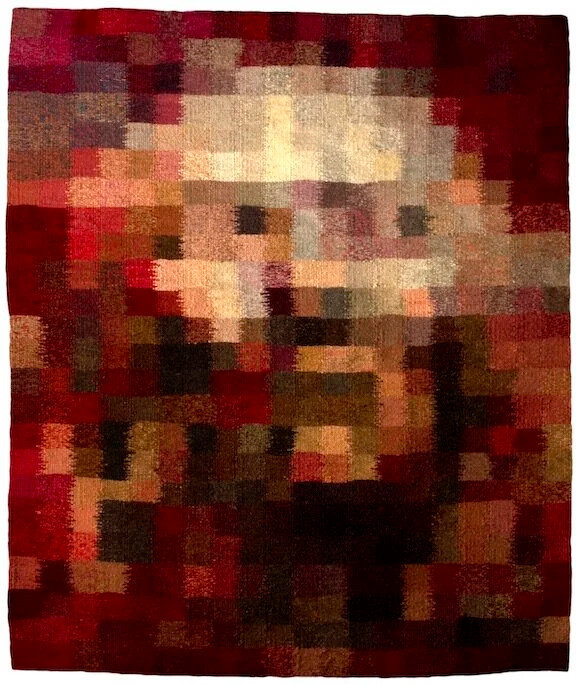
Michael F. Rohde
Balance
2014
Handwoven tapestry: wool, alpaca, camel, silk, llama;
natural dyes
The medium in which I choose to work is fiber, primarily flat woven pieces. I’ve picked this less than common medium, having been drawn to the possibilities of relationships between subliminal texture and the interaction of light and color.
Having taken this route, the weavings can become an embodiment of the freedom to explore how colors relate to each other and to the surface properties of the fibers used. Pure color and specific color combinations of color have the power to speak to each of us, often producing differing responses in each person. By limiting the vocabulary to color and woven texture, the works are better able to stimulate reactions and emotions that these raw color and spatial relationships can have on the viewer.
Recent pieces of work over the last several years have addressed the impact of human and natural causes on the homes and lives of people. These include houses that disappear into the sands of war, are filled with rising flood waters or simply vanish as the natural consequence of time. One set of recent work is a group of tapestry woven pixelated faces, touching on abstraction and reality at the same time. Most recent is a set of large scale “Imagined Language” tapestries.
Yet, without the foreknowledge of what is behind the creation of these images, the works stand as objects of quiet beauty: begun with white yarns of wool, silk, linen and other fibers, I add my own dyes to achieve a range colors and contrast not available in commercially dyed materials. Like a painter, I mix my own colors to create something new.
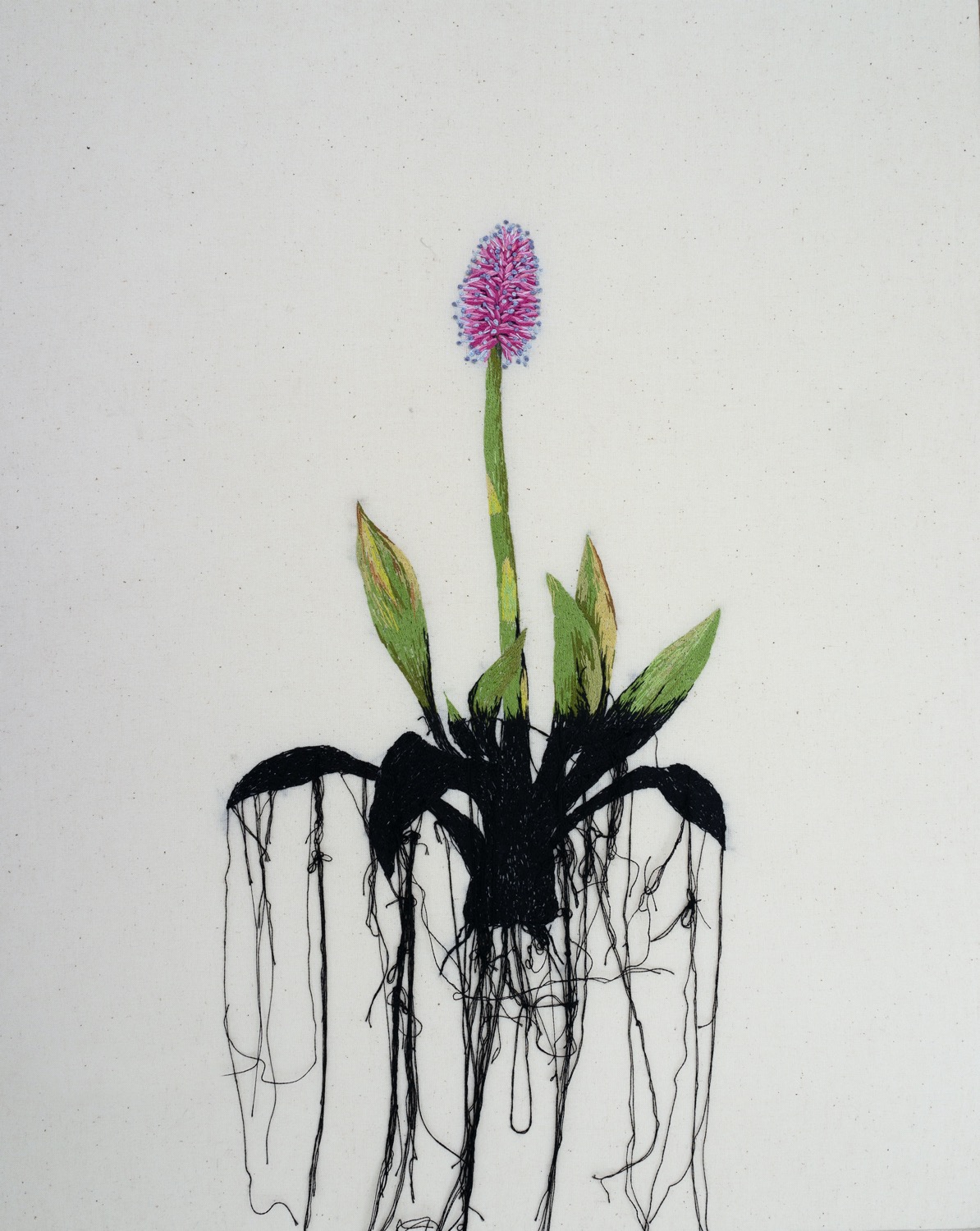
Michelle Robinson
Swamp Pink (imperiled s2)
2025
Cotton embroidery on muslin
The Swamp Pink is an East coast wetland plant that has been reduced to small, pocket populations due to habitat loss. It requires specific soil moisture levels to survive, and is sensitive to water quality. It is federally listed as Threatened and considered Endangered in the state of Virginia.
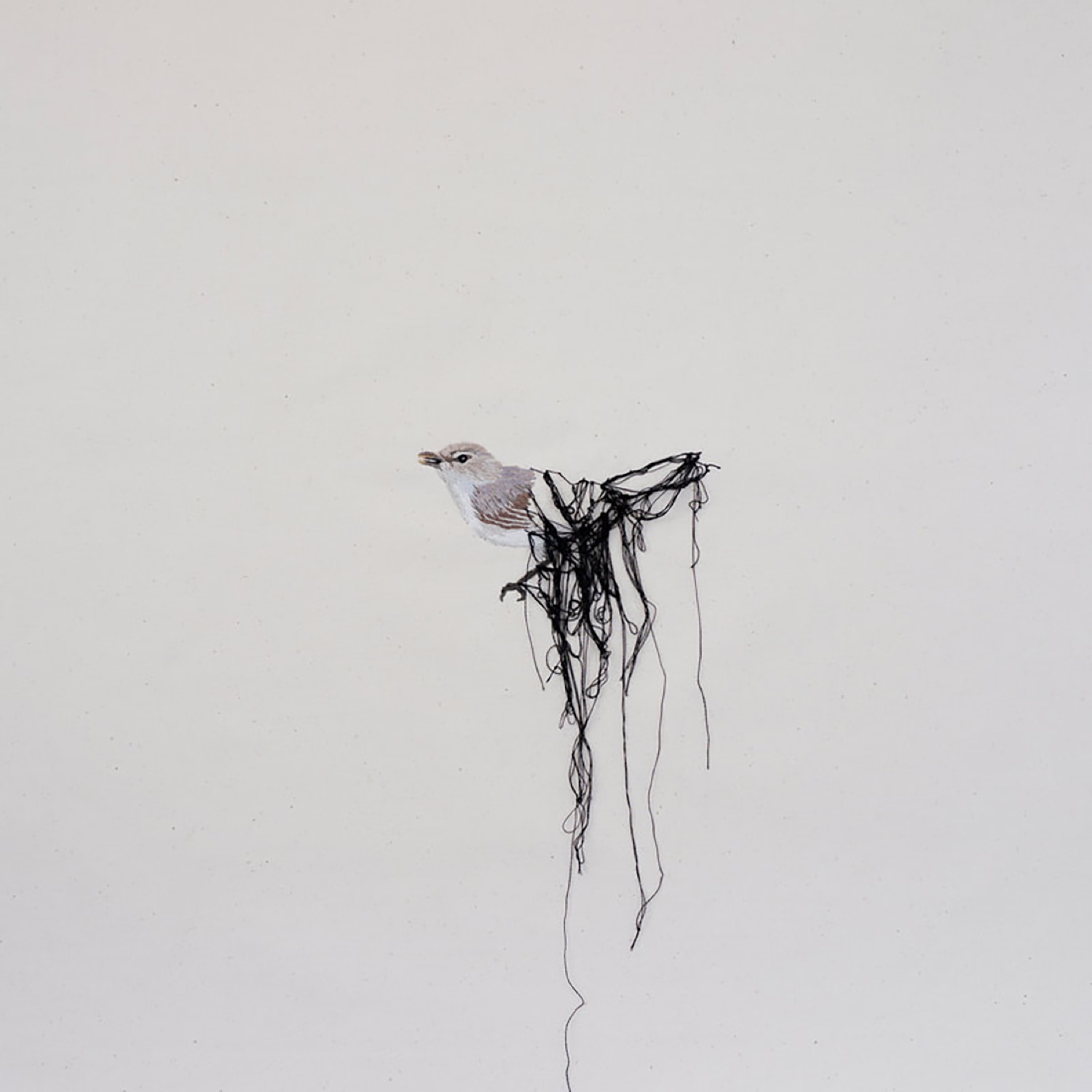
Michelle Robinson
Least Bell’s Vireo (endangered)
2023
Cotton embroidery on muslin
Least Bell’s Vireo is a small songbird that relies on riparian vegetation like willow and mulefat to build its nests and host the insects it feeds upon. Over 95% of its historical habitat has been destroyed, and It is designated as Endangered by both the federal government and the state of California.
A Field Guide to Lost Creatures of the LA River
The Los Angeles River, recently named one of America’s most endangered, takes many forms as it passes through the city, from concrete wastelands to a small stretch of semi-natural wilderness. From the beginning of colonial settlement, the river has been a battleground between the needs of industry and the unpredictability of nature. Rainwater is shuttled straight to the ocean instead of replenishing groundwater basins and freshwater marshes. Its current state is a bittersweet compromise that does not fully serve people, wildlife, or the environment. As a result of the flood control measures taken in the 1930s, the riparian habitat has mostly disappeared, and many species of animals have been extirpated from the river. For each embroidered, life-size portrait, the amount of black, unraveling thread can be read as an indicator of their threatened status in the state.
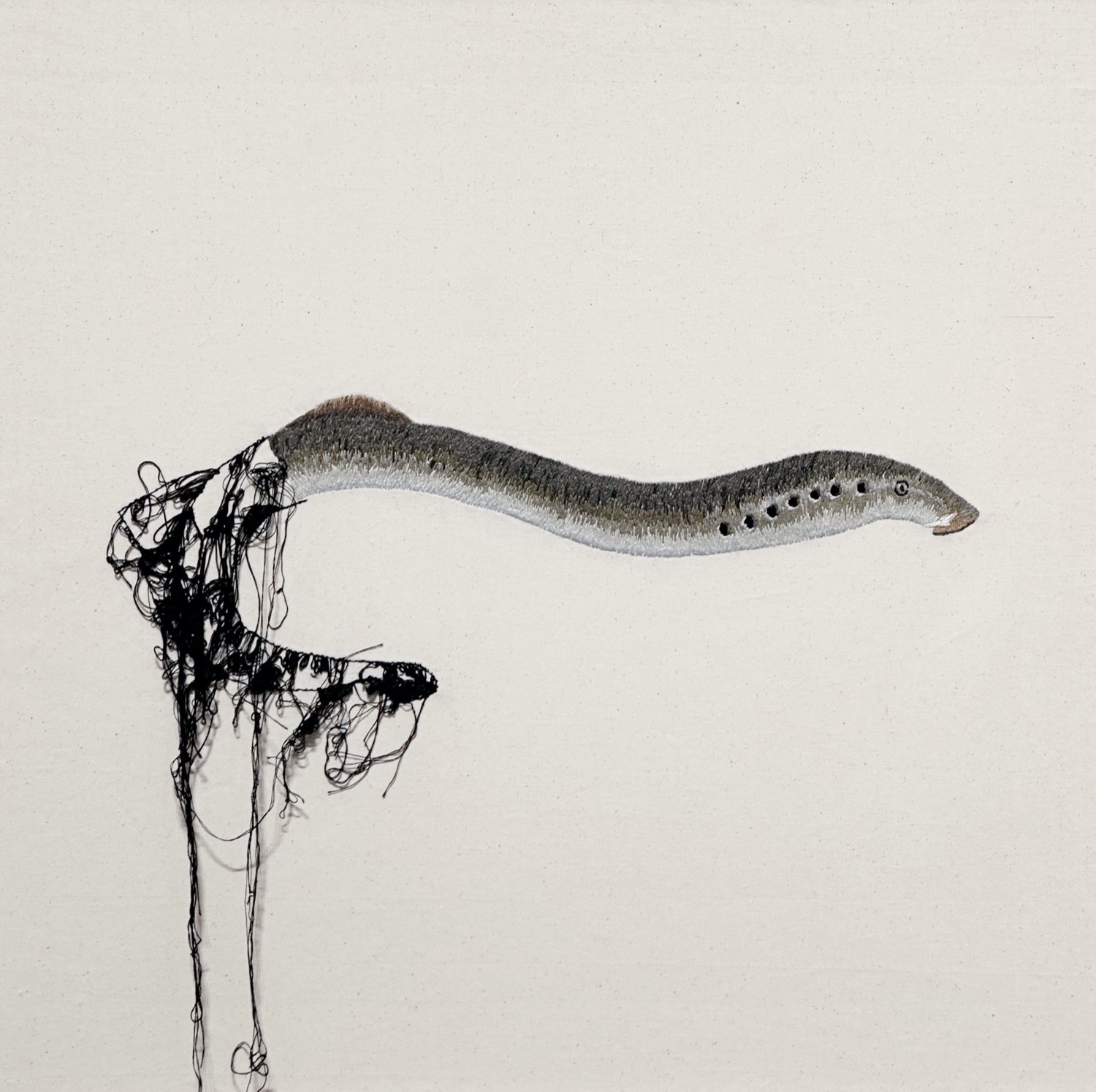
Michelle Robinson
Pacific Lamprey (threatened)
2023
Cotton embroidery on muslin
The Pacific Lamprey, an ancient species which once spawned in the Los Angeles River, is a culturally important fish for the Tongva people, used for food, medicine, and ceremonial purposes. Like salmon, it spawns in freshwater streams and is in decline due to barriers and other condition changes in the waterways it depends on. It is designated as a Species of Special Concern in California.
A Field Guide to Lost Creatures of the LA River
The Los Angeles River, recently named one of America’s most endangered, takes many forms as it passes through the city, from concrete wastelands to a small stretch of semi-natural wilderness. From the beginning of colonial settlement, the river has been a battleground between the needs of industry and the unpredictability of nature. Rainwater is shuttled straight to the ocean instead of replenishing groundwater basins and freshwater marshes. Its current state is a bittersweet compromise that does not fully serve people, wildlife, or the environment. As a result of the flood control measures taken in the 1930s, the riparian habitat has mostly disappeared, and many species of animals have been extirpated from the river. For each embroidered, life-size portrait, the amount of black, unraveling thread can be read as an indicator of their threatened status in the state.
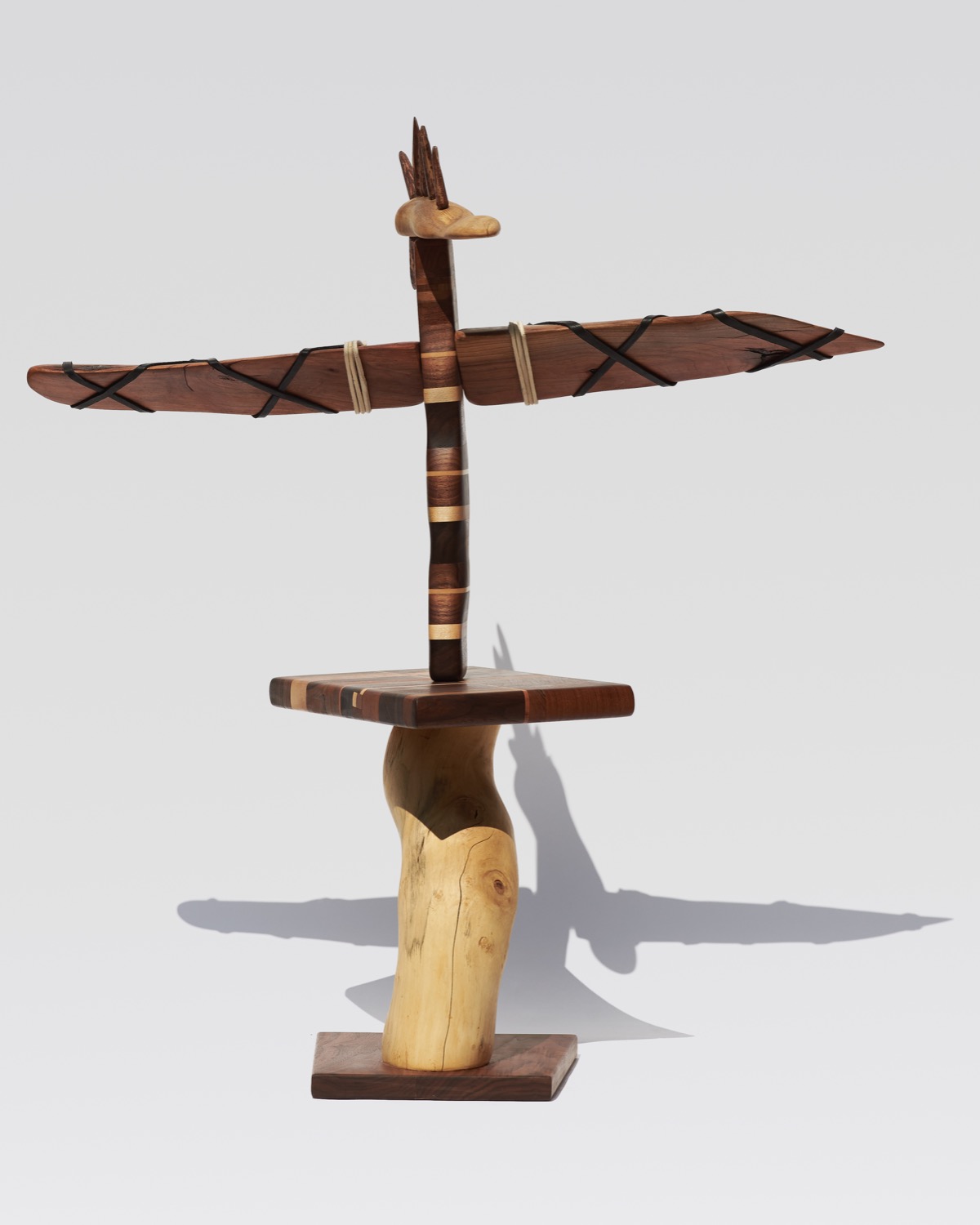
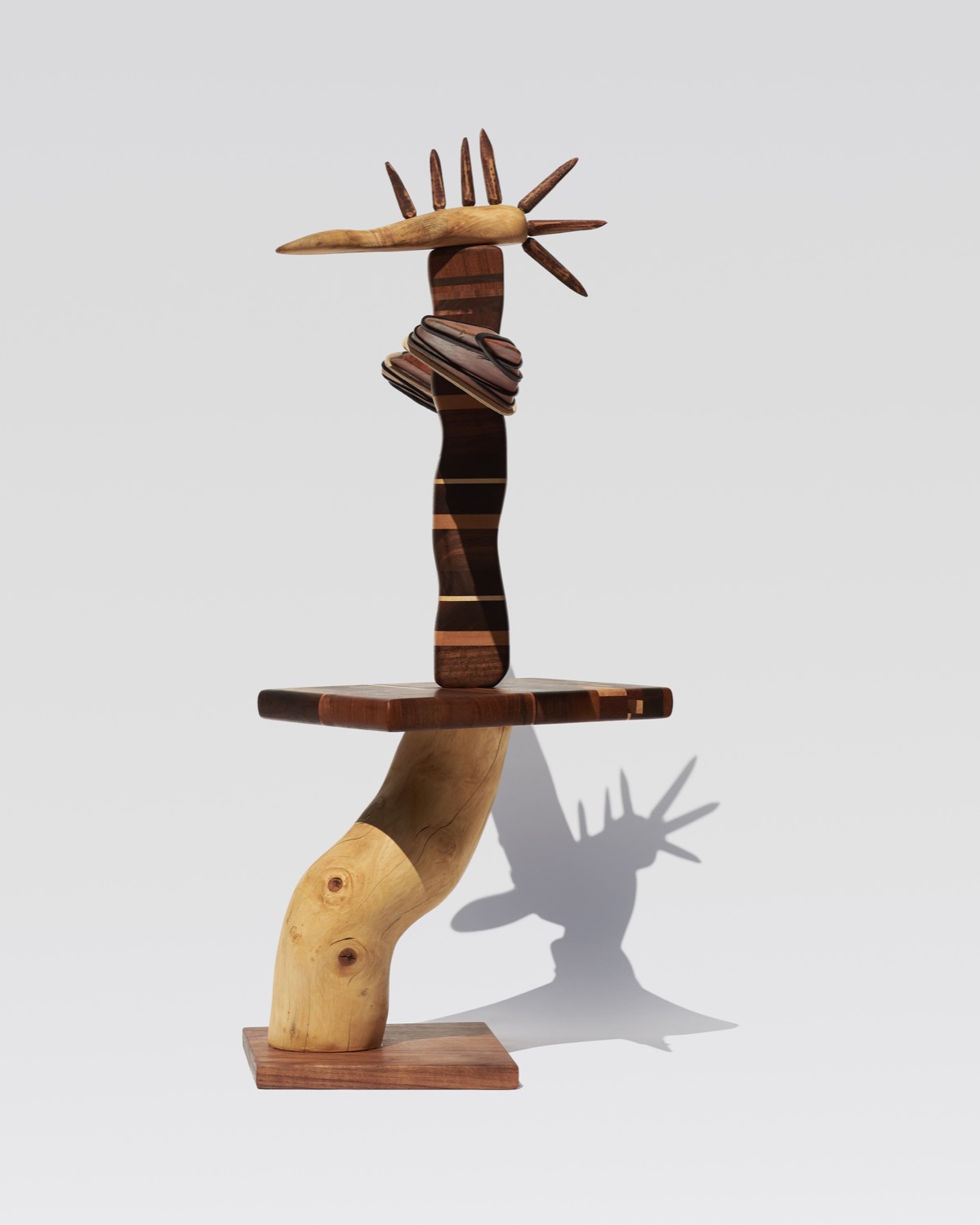
Lorenzo Hurtado Segovia
Kuntur Amaru
Pecan, lemon, walnut, oak, maple, ipe, and leather
31″ x 28″ x 14″
Kuntur Amaru is a sculpture inspired by the Quechua word for Condor, the largest flying bird of the Americas and Túpac Amaru, the last Inca leader resisting European colonizers. This cruciform sculpture merges a representation of a condor and the Christian Cross.
My artwork is rooted in craft traditions informed by Judeo-Christian and Indigenous theology, art history, and ethnographic motifs. Their materials and processes are varied and inspired by textiles, world crafts, painting, embroidery, weaving, and carpentry. The resulting aesthetic is an intricate and multi-layered synthesis of figuration, abstraction, and decoration. The meanings that unfold are emotional, social, philosophical, and personal. My hope and vision are to bring Christian themes into the contemporary art world as a relevant subject of discourse. I am inspired by how various peoples interpret beliefs and in the many ways they are represented through ritual and artifact.
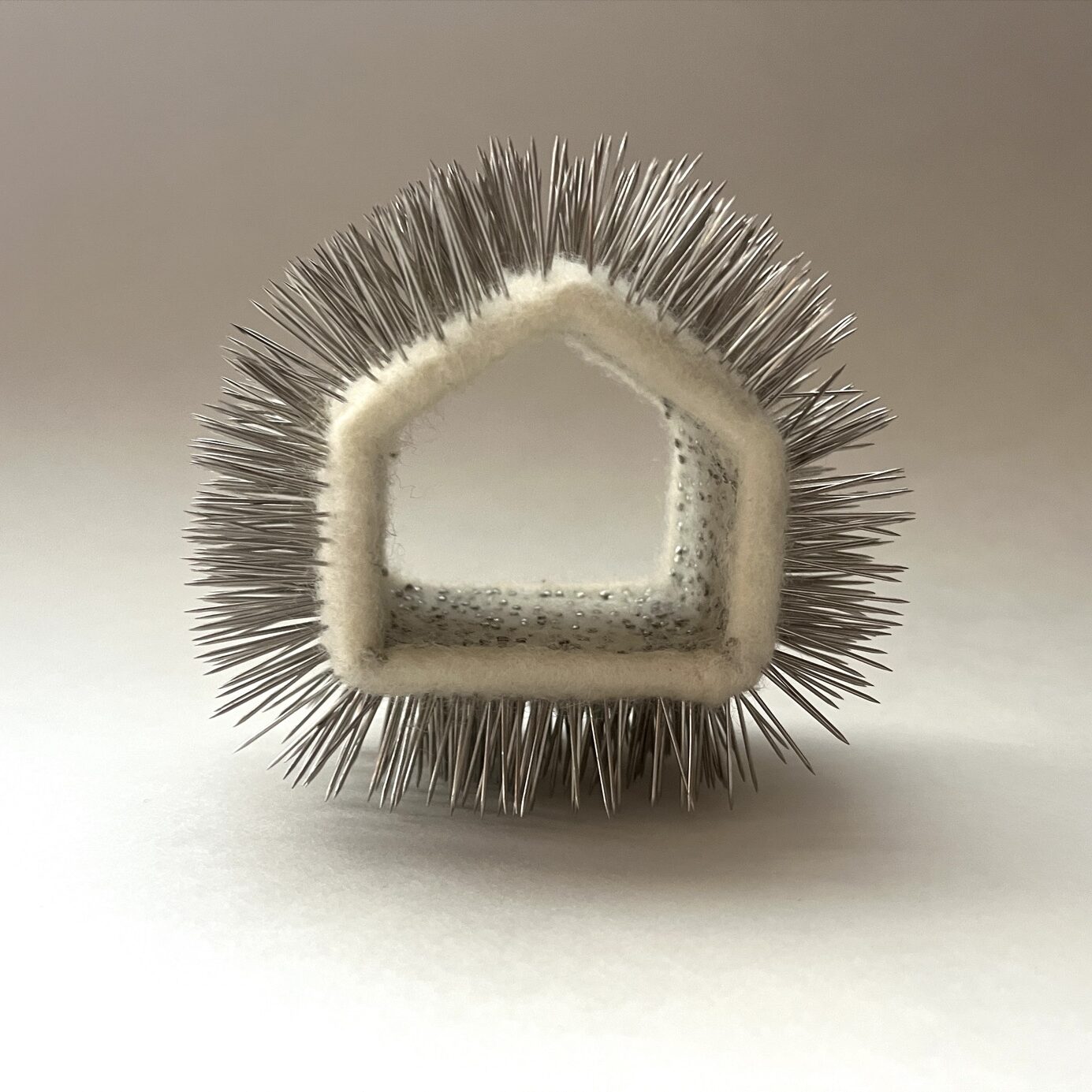
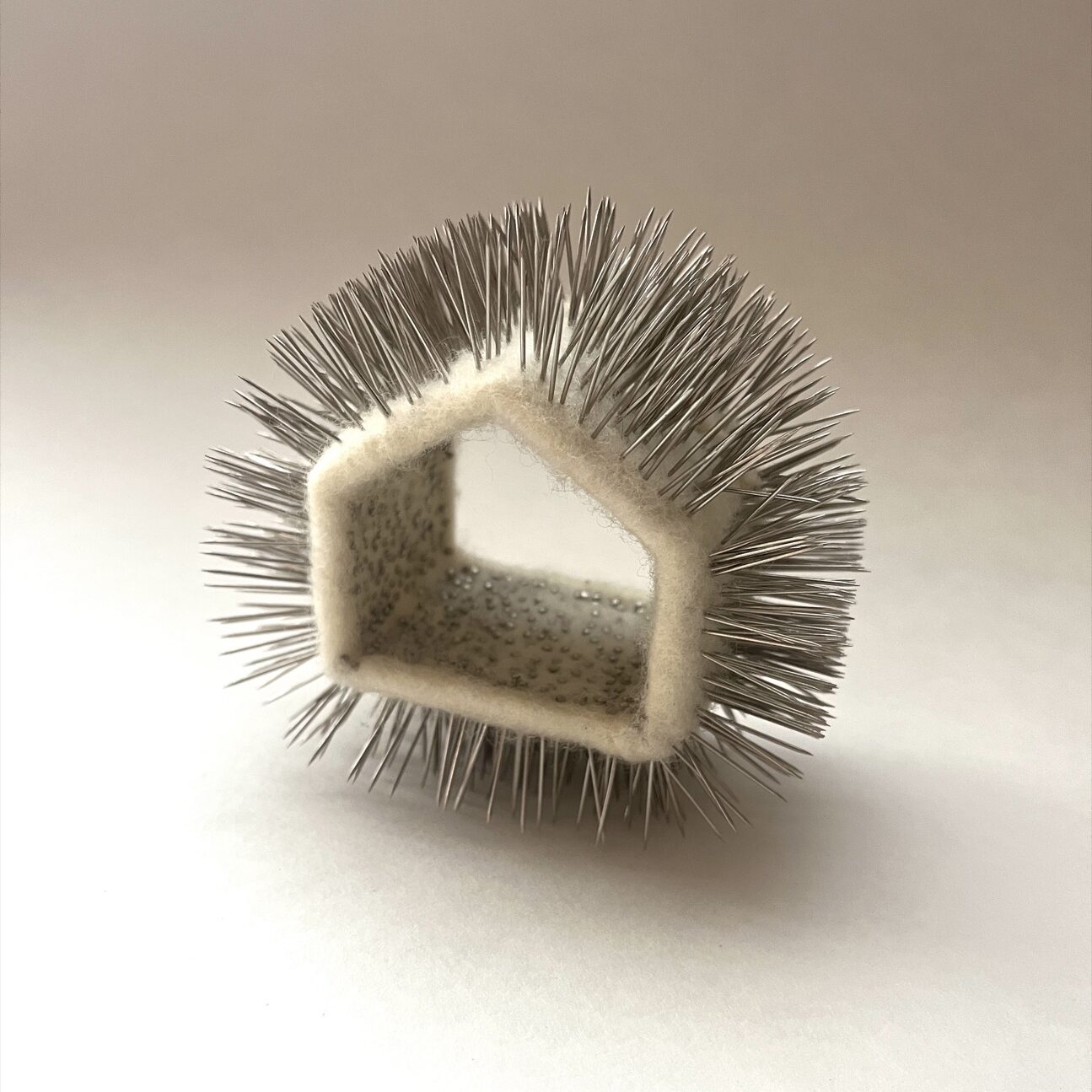
Lydia Tjioe Hall
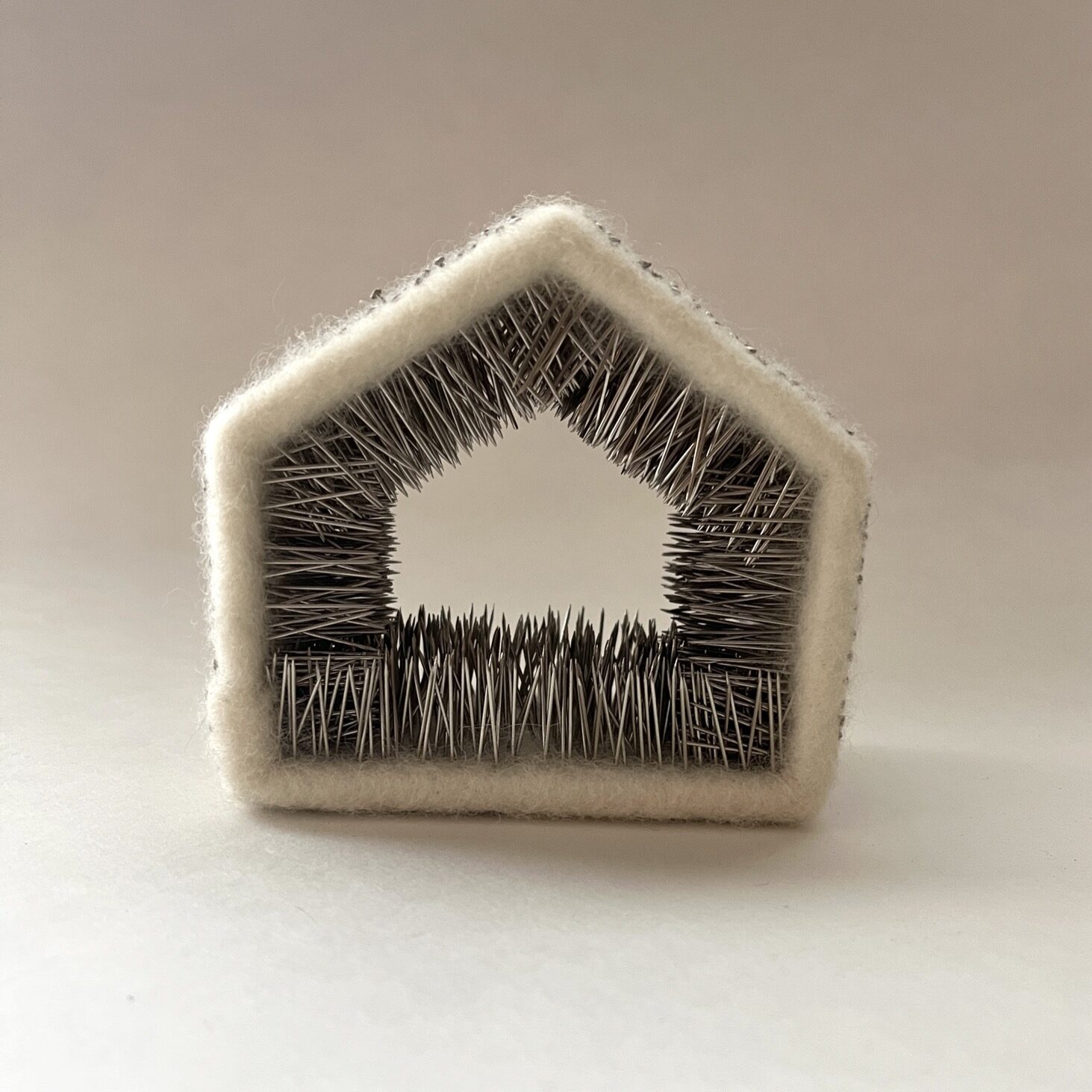
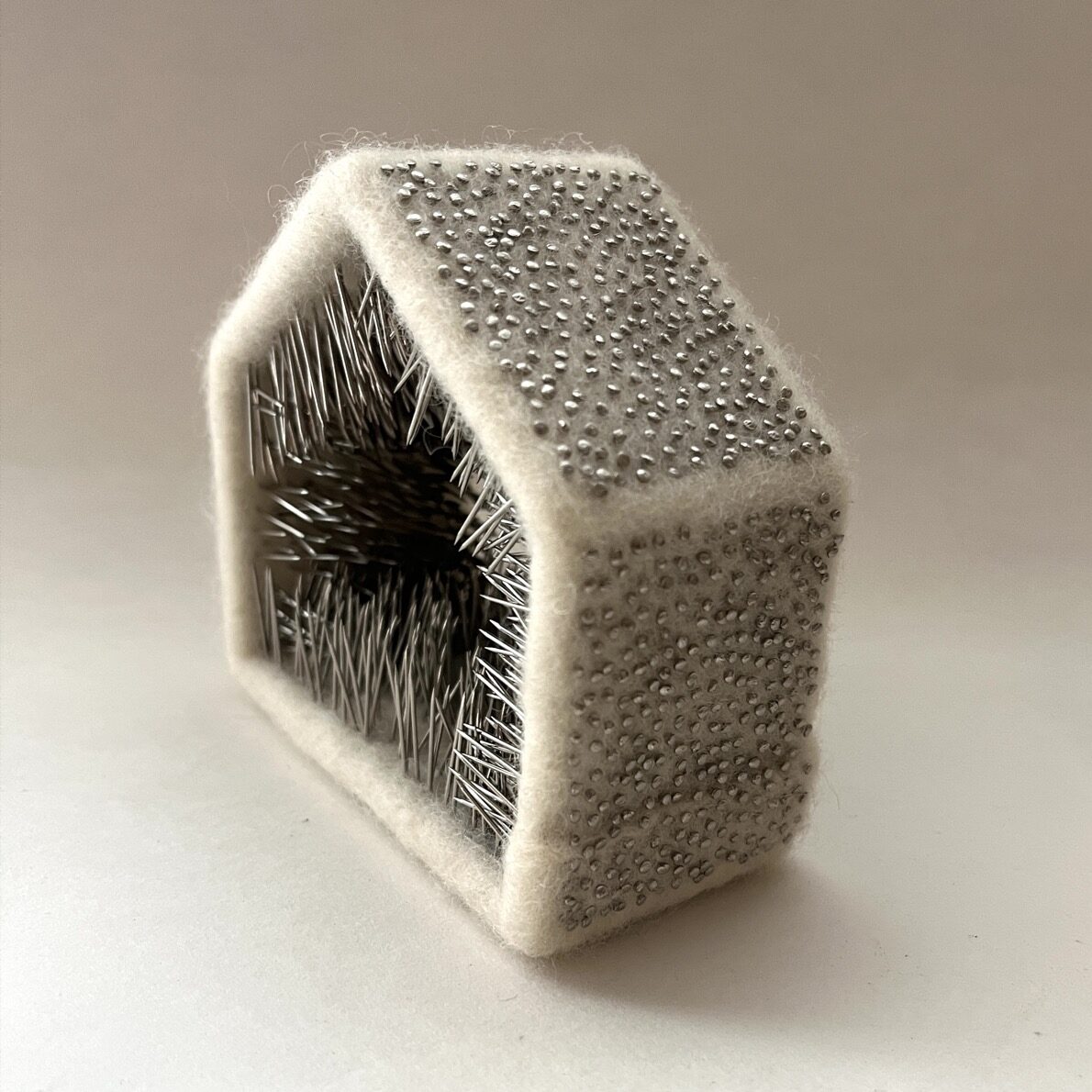
House with Needles Outside
2026
Wool, needles
3”x 3”x 2”
Lydia Tjioe Hall
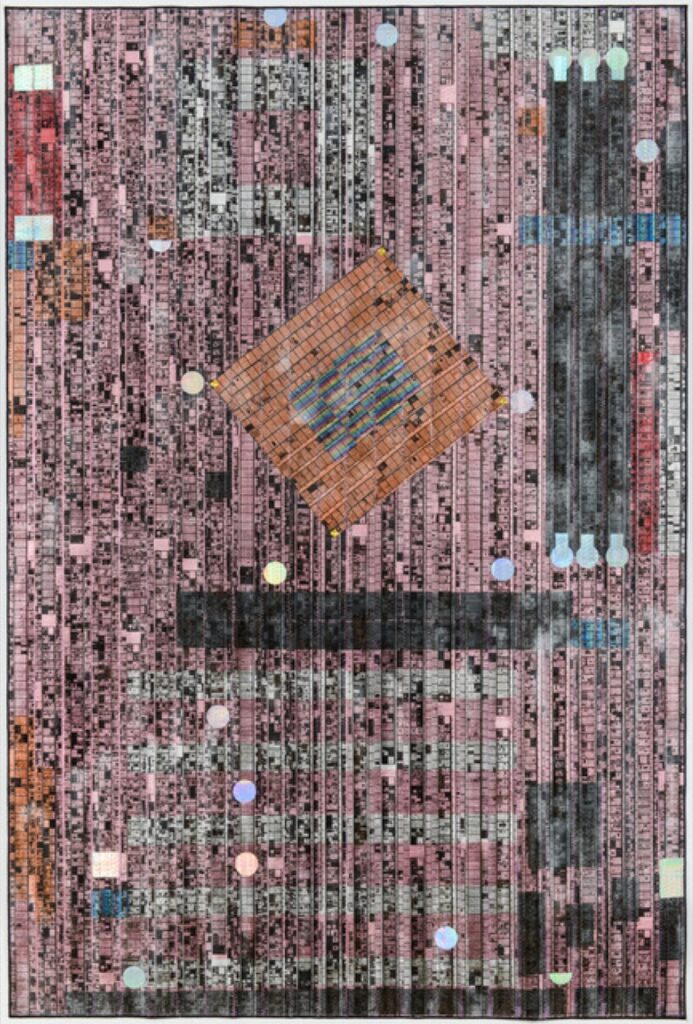
House with Needles Inside
2026
Wool, needles
3”x 3”x 2”
Arturo Alonzo Sandoval
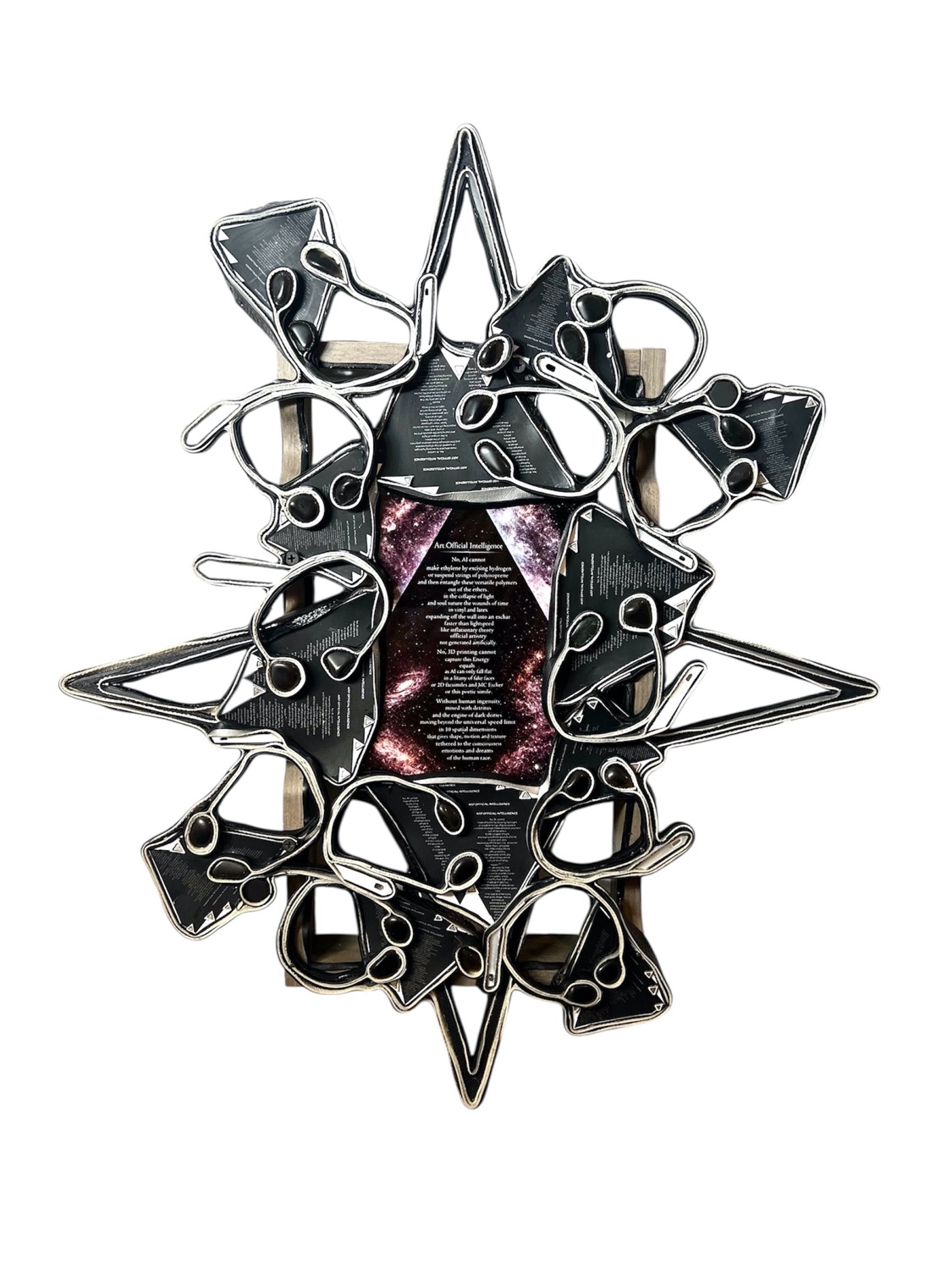
Pattern Fusion No. 14: Motherboard 5 (pink)
2016
Layered, splicing, machine stitched and interlaced; repurposed auto industry Mylar, recycled library 35 mm microfilm, transparent polyester film, monofilament and multi-colored threads, plaited braid edging, Holographic film, Pellon, polymer medium, and fabric backed.
80.5” x 54”
Alicia Piller
Art Official Intelligence. (Poem 2)
Vinyl, recycled leather, recycled 3-D printed parts, wood, HD metal print, acrylic paint, photos on Archival Matte Fine Art Paper, smoky quartz.
23.5”h x 19.75”w x 2.25”d
Poem by Felipe Findley
My work draws from the structures of cellular biology to locate the root of human histories, using material as both subject and language. Through sculpture and installation, I construct layered systems where macro and micro perspectives collapse, revealing how bodies, environments, and social conditions shape one another over time.
Materiality is central to my process. I work with recycled textiles, industrial fragments, xeroxed imagery, resin, latex, and natural elements, combining them through acts of wrapping, binding, casting, and accumulation. These materials carry memory. They are cut, braided, and encased into membrane-like forms that build into larger organisms. Each work becomes a physical manifestation of thought, memory, and historical residue, suspended between construction and decay.
My practice is grounded in craft traditions passed through my African American maternal lineage and an ethic of repair inherited from my Jewish American paternal background. These influences shape my approach to sculpture as a site of transformation, where inherited knowledge and lived experience converge. My background in painting and anthropology further informs an ongoing engagement with global craft, material culture, and systems of meaning.
Increasingly, my work expands into immersive and suspended environments. These installations function as porous ecosystems, allowing viewers to move around and through them, encountering forms that shift between the bodily, the architectural, and the cosmic.
Across my practice, I investigate trauma, adaptation, and repair. The work holds rupture alongside resilience, proposing new ways of understanding how histories are metabolized and carried forward through material form.
Alicia Piller
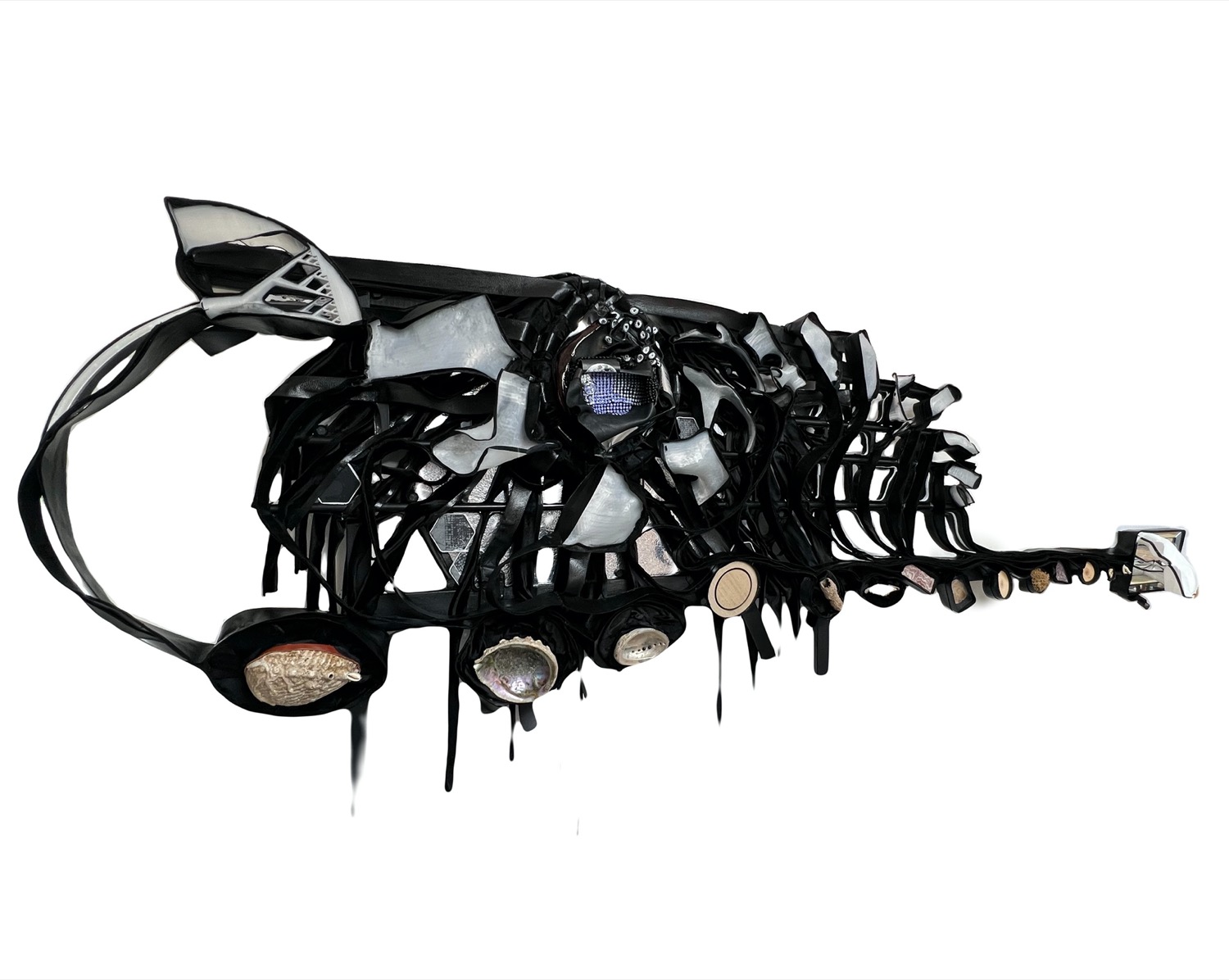
Synthetic Horizon. Fossil Future.
Velvet, vinyl, recycled leather, photos on paper: deceased humans AI & 1982 astronomy book, screen, 3-D printed parts, magnifying glass, wood, metal, acrylic paint, resin, abalone shell, sea sponge, jasper, coral, mirror, tile.
45”h x 111”w x 10.75”d
My work draws from the structures of cellular biology to locate the root of human histories, using material as both subject and language. Through sculpture and installation, I construct layered systems where macro and micro perspectives collapse, revealing how bodies, environments, and social conditions shape one another over time.
Materiality is central to my process. I work with recycled textiles, industrial fragments, xeroxed imagery, resin, latex, and natural elements, combining them through acts of wrapping, binding, casting, and accumulation. These materials carry memory. They are cut, braided, and encased into membrane-like forms that build into larger organisms. Each work becomes a physical manifestation of thought, memory, and historical residue, suspended between construction and decay.
My practice is grounded in craft traditions passed through my African American maternal lineage and an ethic of repair inherited from my Jewish American paternal background. These influences shape my approach to sculpture as a site of transformation, where inherited knowledge and lived experience converge. My background in painting and anthropology further informs an ongoing engagement with global craft, material culture, and systems of meaning.
Increasingly, my work expands into immersive and suspended environments. These installations function as porous ecosystems, allowing viewers to move around and through them, encountering forms that shift between the bodily, the architectural, and the cosmic.
Across my practice, I investigate trauma, adaptation, and repair. The work holds rupture alongside resilience, proposing new ways of understanding how histories are metabolized and carried forward through material form.
Alicia Piller
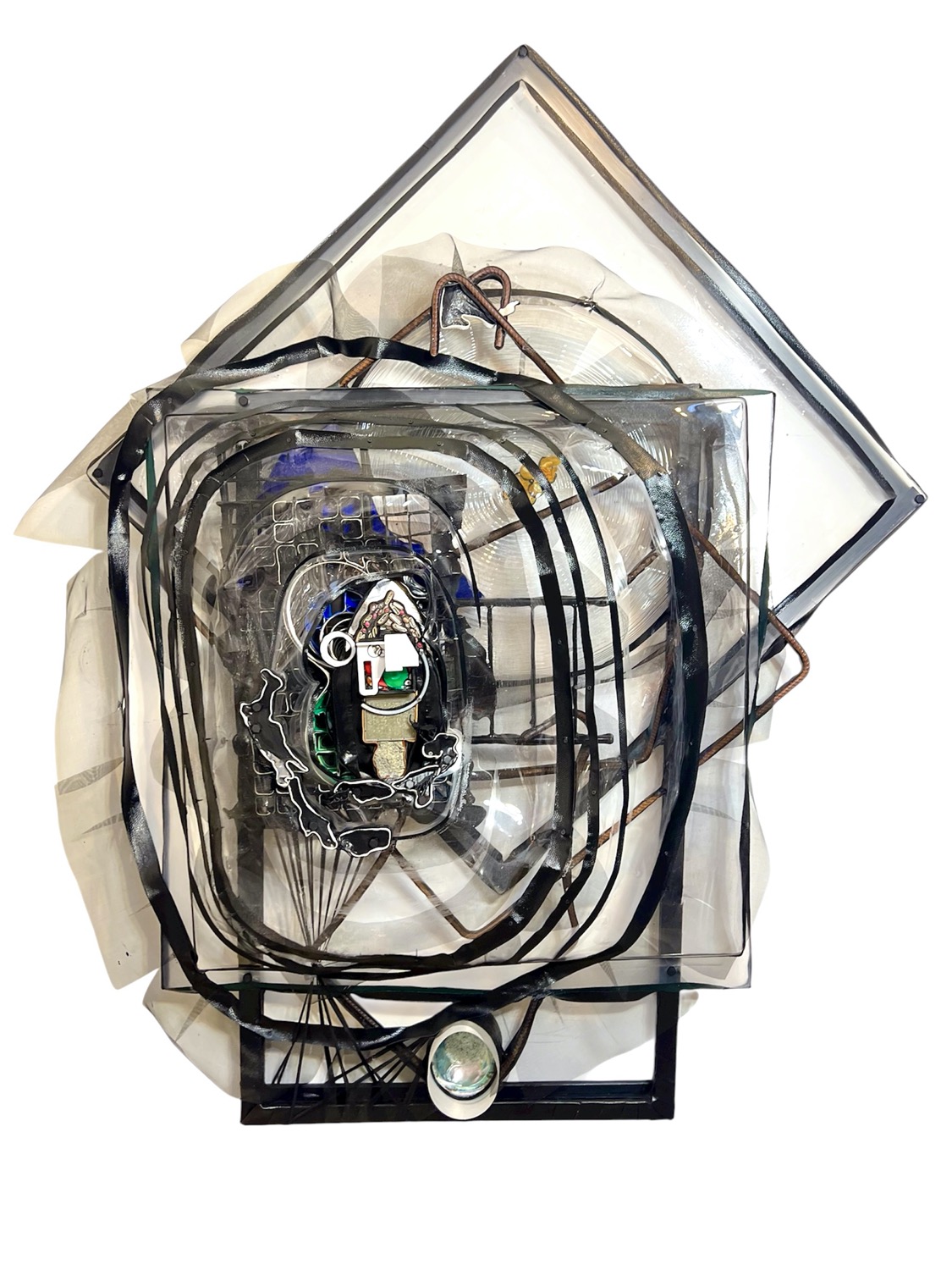
Inherited Momentum. Ongoing Ascent.
Vinyl, recycled leather, photos on paper: Octavia Butler, magnifying glass, screen, 3-D printed parts, wood, metal, acrylic paint, resin, abalone shell, tile, clock spring, quartz, paper, beads, plastic, rebar, mirror.
86” h x 67”w x 10”d
My work draws from the structures of cellular biology to locate the root of human histories, using material as both subject and language. Through sculpture and installation, I construct layered systems where macro and micro perspectives collapse, revealing how bodies, environments, and social conditions shape one another over time.
Materiality is central to my process. I work with recycled textiles, industrial fragments, xeroxed imagery, resin, latex, and natural elements, combining them through acts of wrapping, binding, casting, and accumulation. These materials carry memory. They are cut, braided, and encased into membrane-like forms that build into larger organisms. Each work becomes a physical manifestation of thought, memory, and historical residue, suspended between construction and decay.
My practice is grounded in craft traditions passed through my African American maternal lineage and an ethic of repair inherited from my Jewish American paternal background. These influences shape my approach to sculpture as a site of transformation, where inherited knowledge and lived experience converge. My background in painting and anthropology further informs an ongoing engagement with global craft, material culture, and systems of meaning.
Increasingly, my work expands into immersive and suspended environments. These installations function as porous ecosystems, allowing viewers to move around and through them, encountering forms that shift between the bodily, the architectural, and the cosmic.
Across my practice, I investigate trauma, adaptation, and repair. The work holds rupture alongside resilience, proposing new ways of understanding how histories are metabolized and carried forward through material form.
Alicia Piller
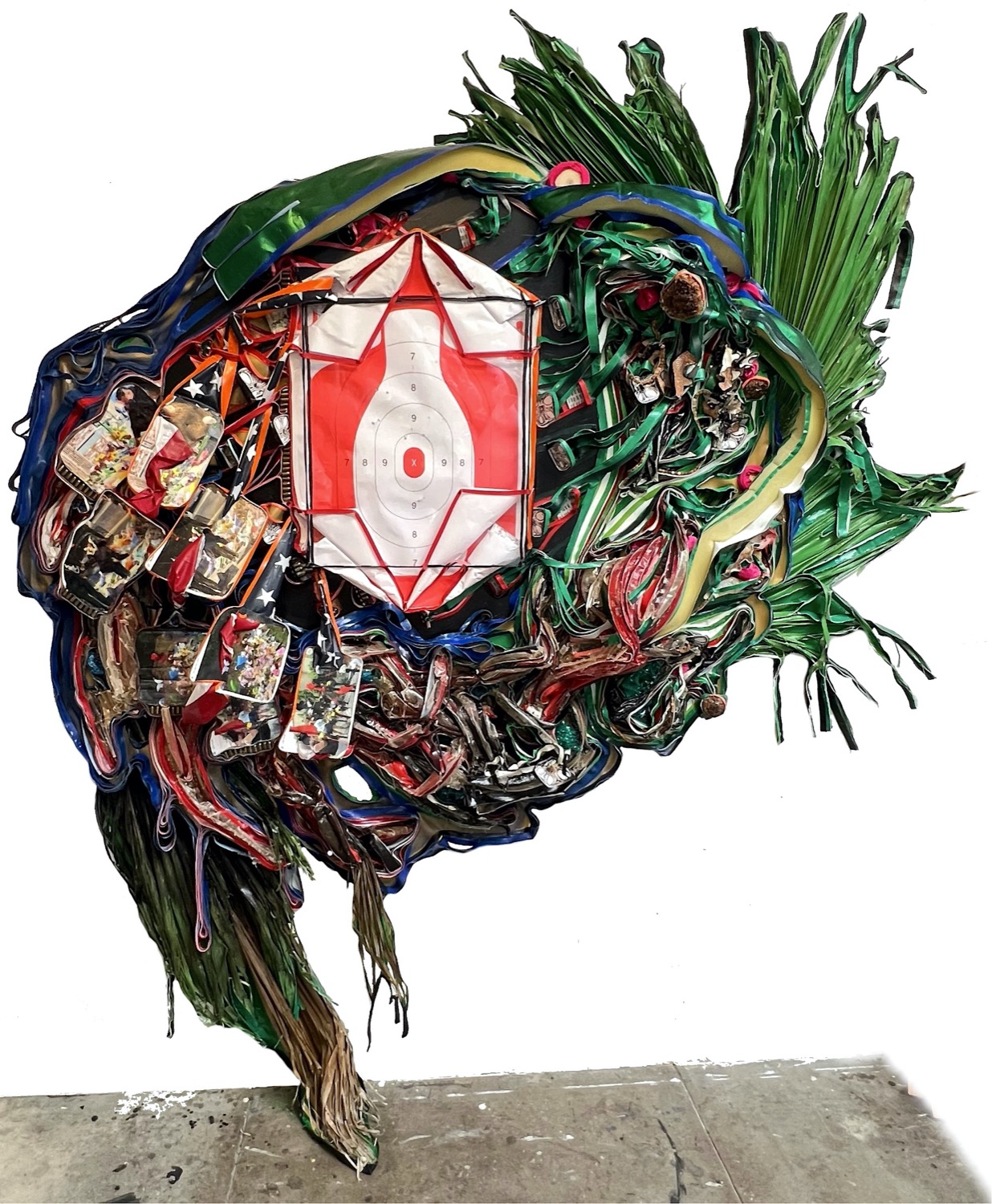
Memorials. From Sea to Shining Sea.
Vinyl, paper, plastic, latex balloons, resin, acrylic, leather, wood, foam, palm fronds, sunflowers, bullet casings, American flag, used shooting targets.
111″ H X 98″ W X 12″ D
My work draws from the structures of cellular biology to locate the root of human histories, using material as both subject and language. Through sculpture and installation, I construct layered systems where macro and micro perspectives collapse, revealing how bodies, environments, and social conditions shape one another over time.
Materiality is central to my process. I work with recycled textiles, industrial fragments, xeroxed imagery, resin, latex, and natural elements, combining them through acts of wrapping, binding, casting, and accumulation. These materials carry memory. They are cut, braided, and encased into membrane-like forms that build into larger organisms. Each work becomes a physical manifestation of thought, memory, and historical residue, suspended between construction and decay.
My practice is grounded in craft traditions passed through my African American maternal lineage and an ethic of repair inherited from my Jewish American paternal background. These influences shape my approach to sculpture as a site of transformation, where inherited knowledge and lived experience converge. My background in painting and anthropology further informs an ongoing engagement with global craft, material culture, and systems of meaning.
Increasingly, my work expands into immersive and suspended environments. These installations function as porous ecosystems, allowing viewers to move around and through them, encountering forms that shift between the bodily, the architectural, and the cosmic.
Across my practice, I investigate trauma, adaptation, and repair. The work holds rupture alongside resilience, proposing new ways of understanding how histories are metabolized and carried forward through material form.
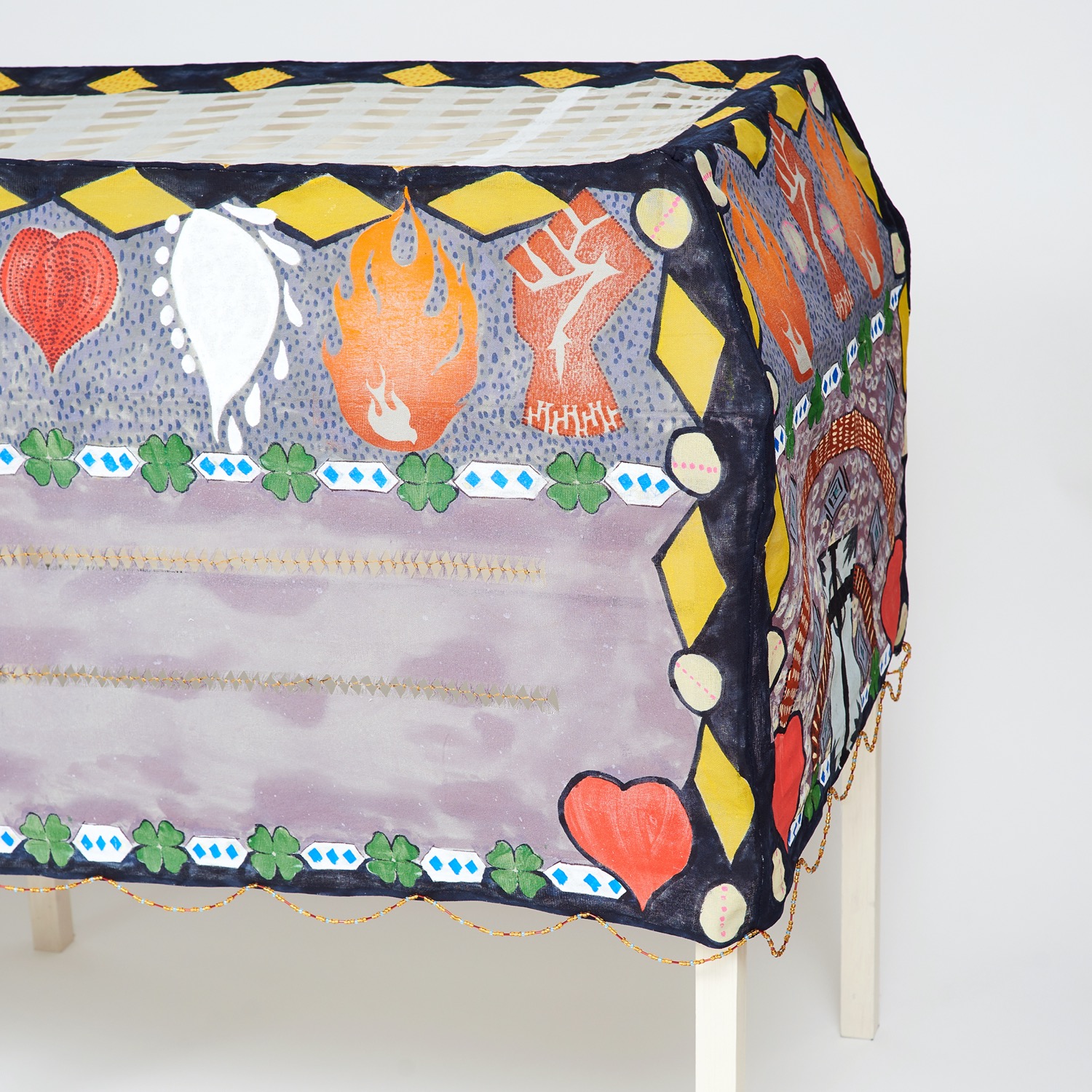
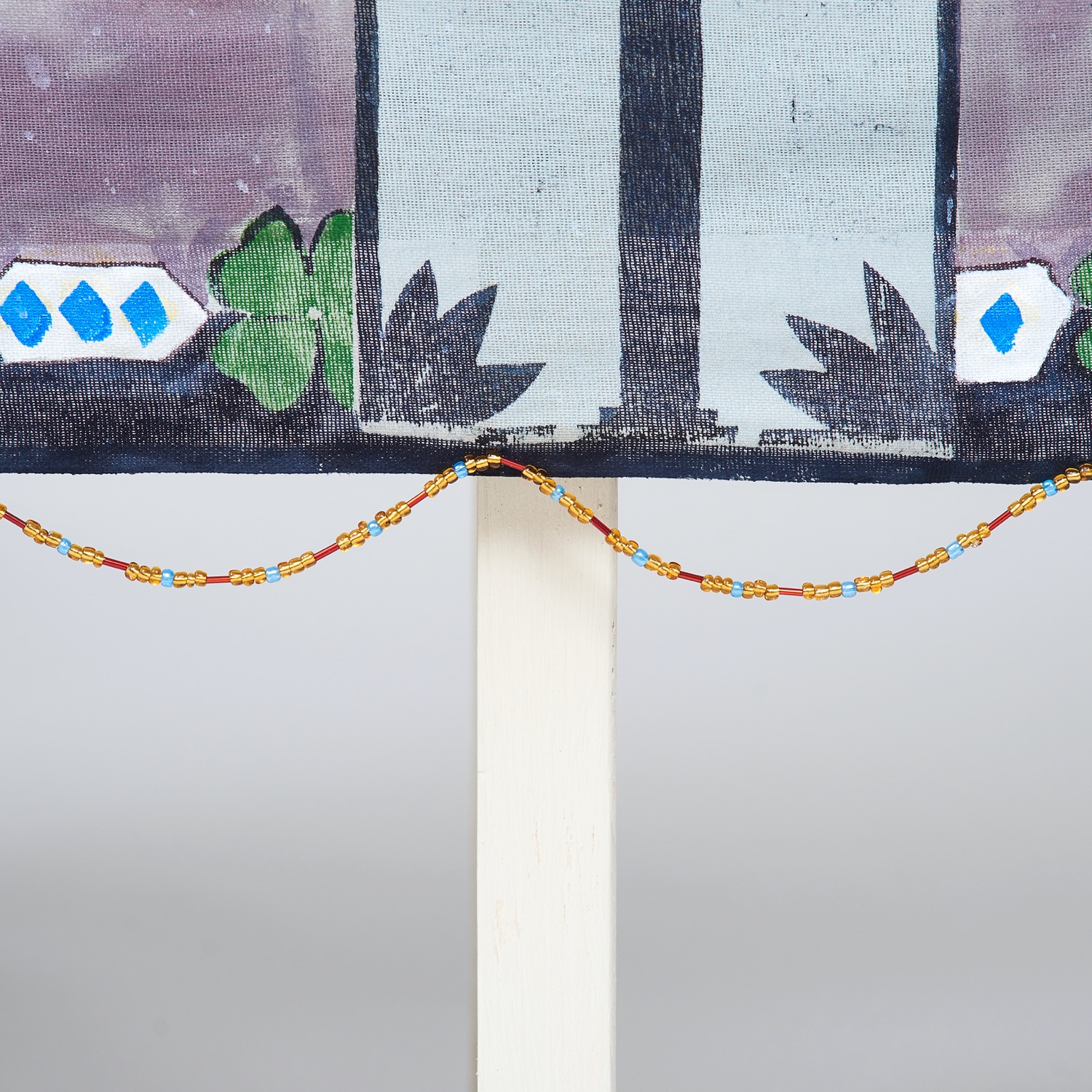
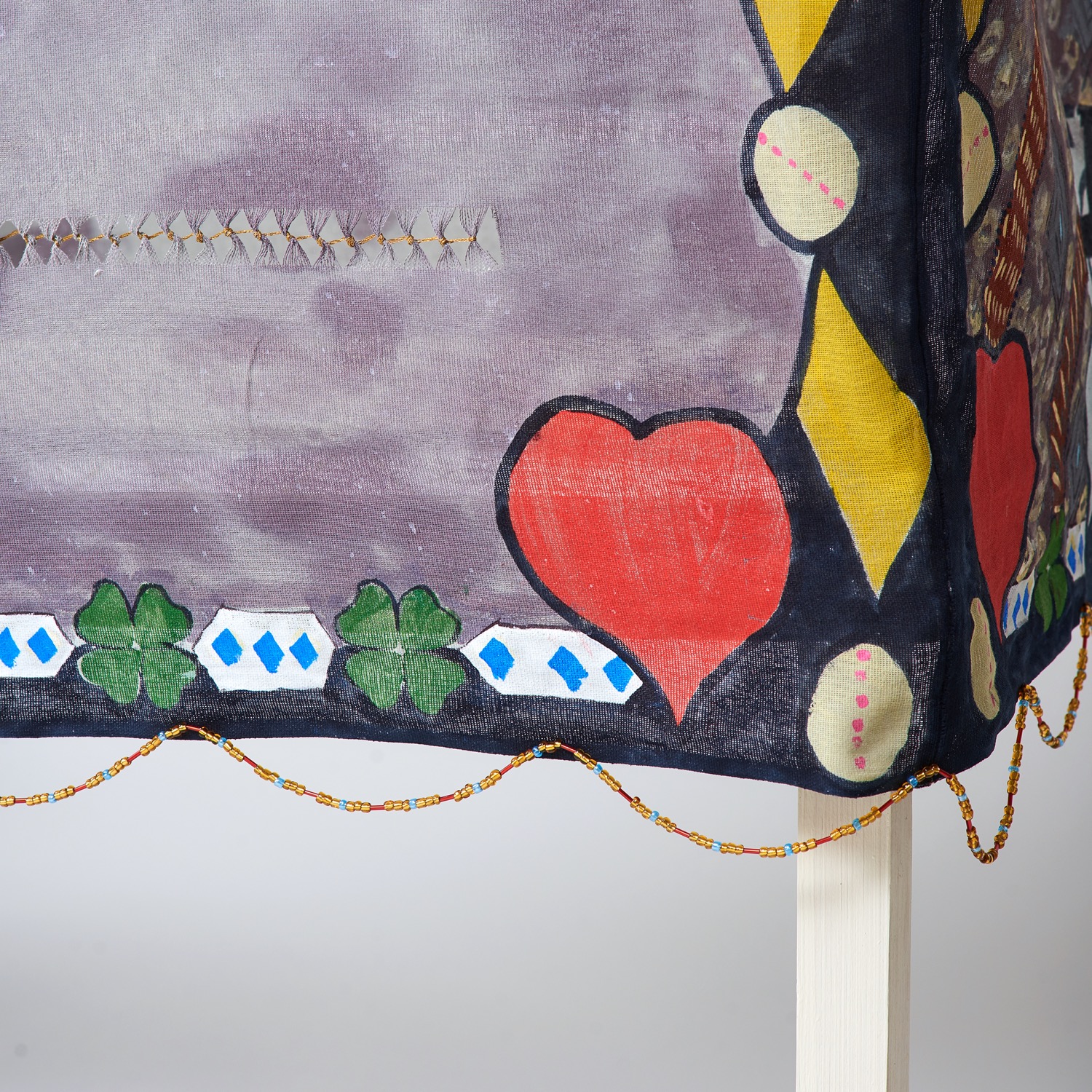
Lorenzo Hurtado Segovia
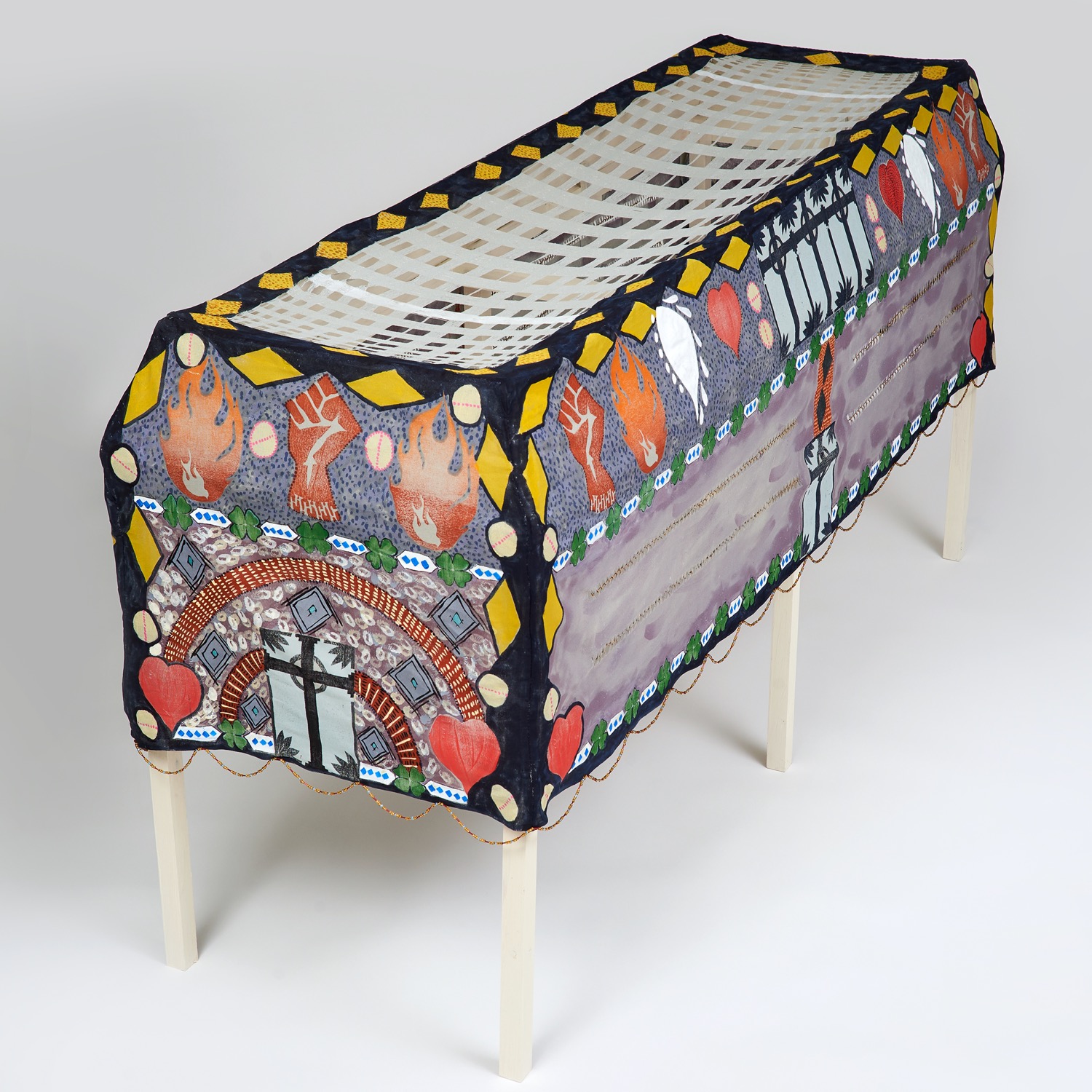
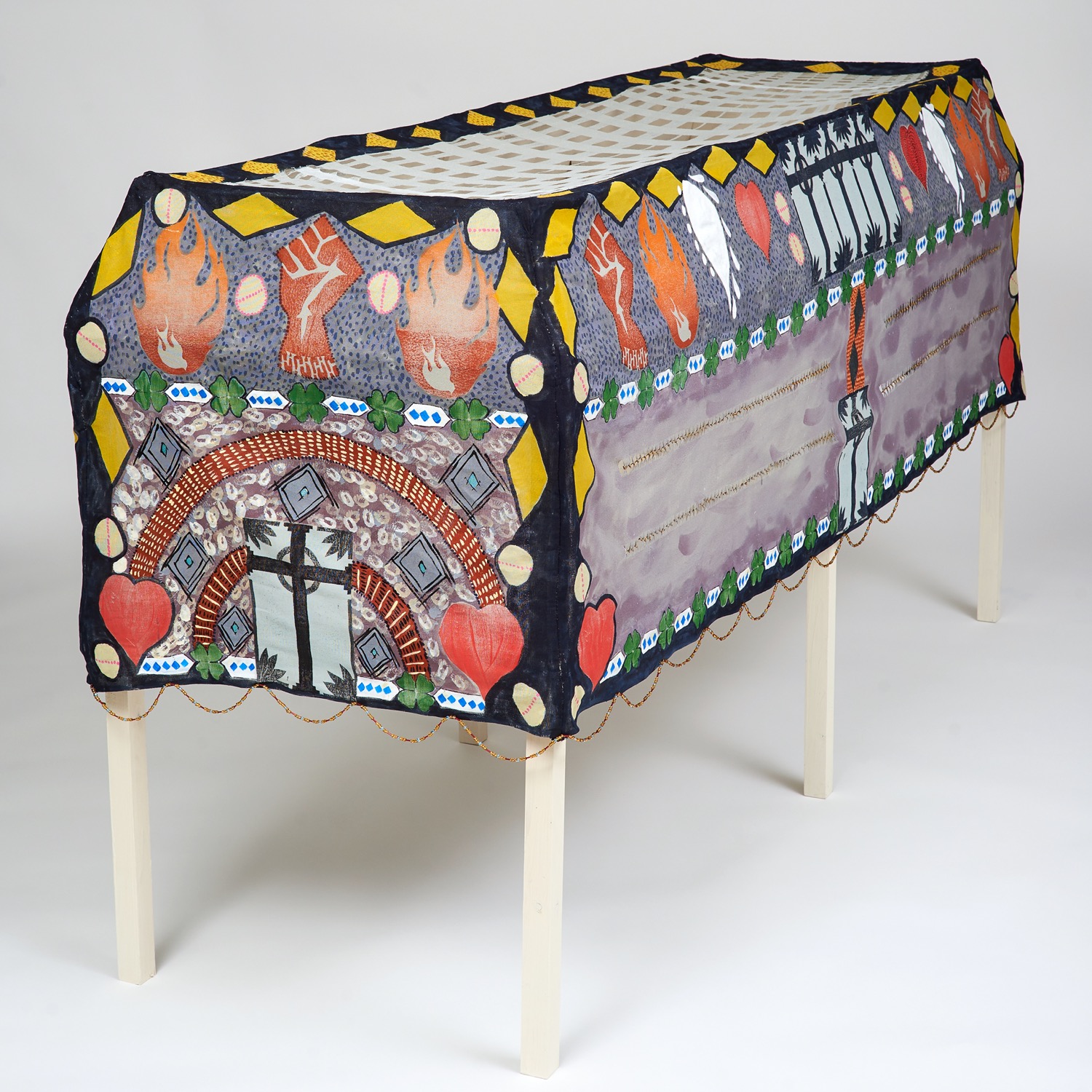
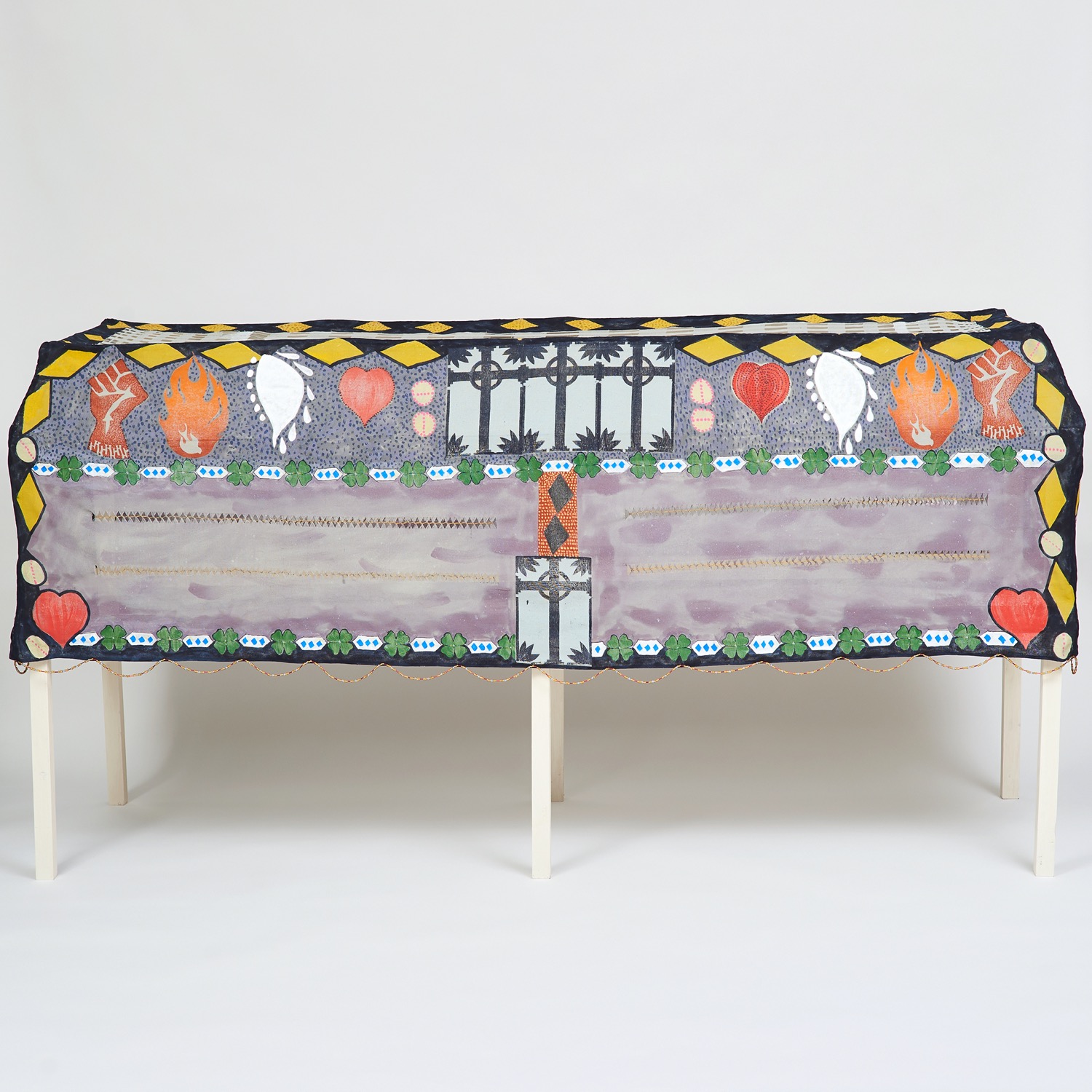
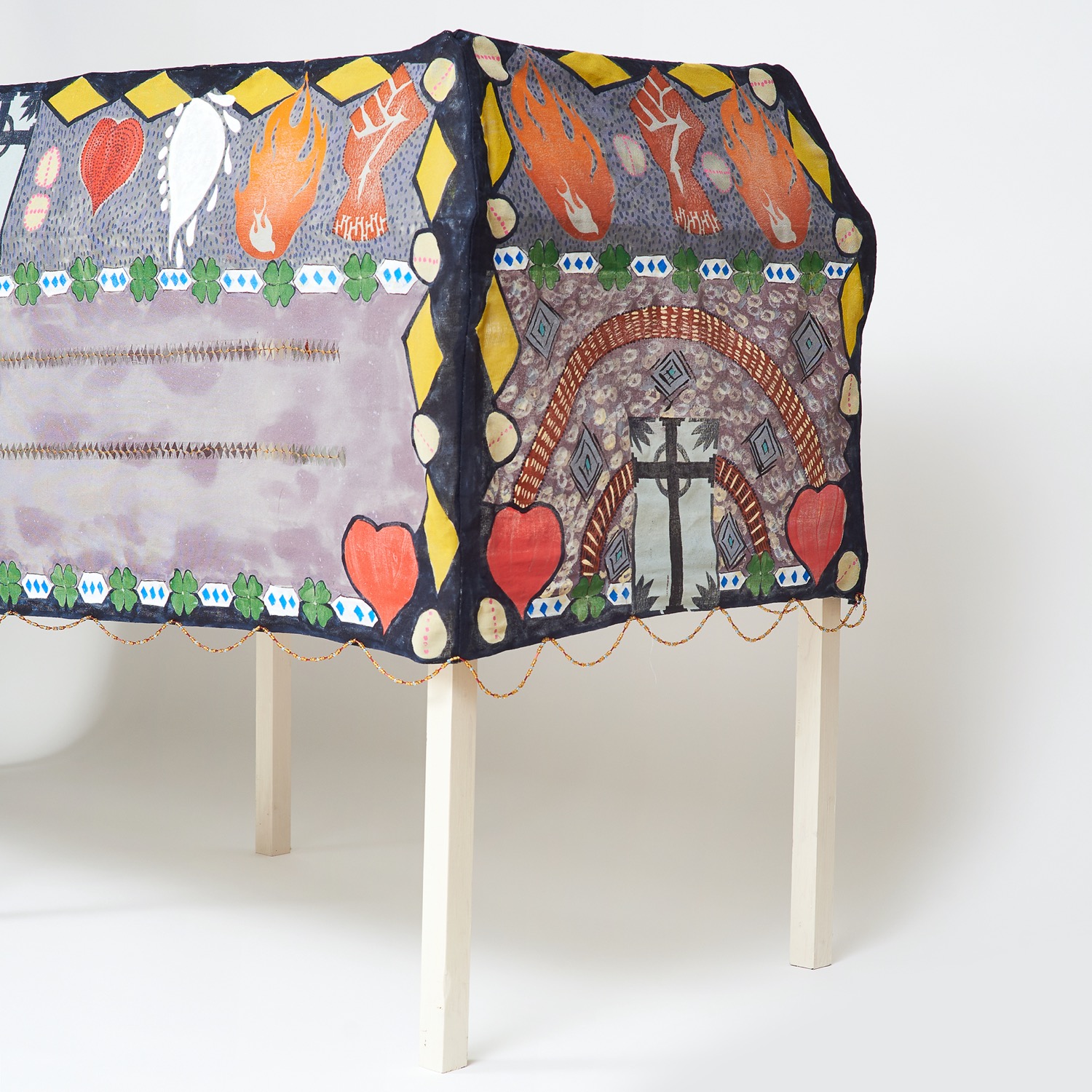
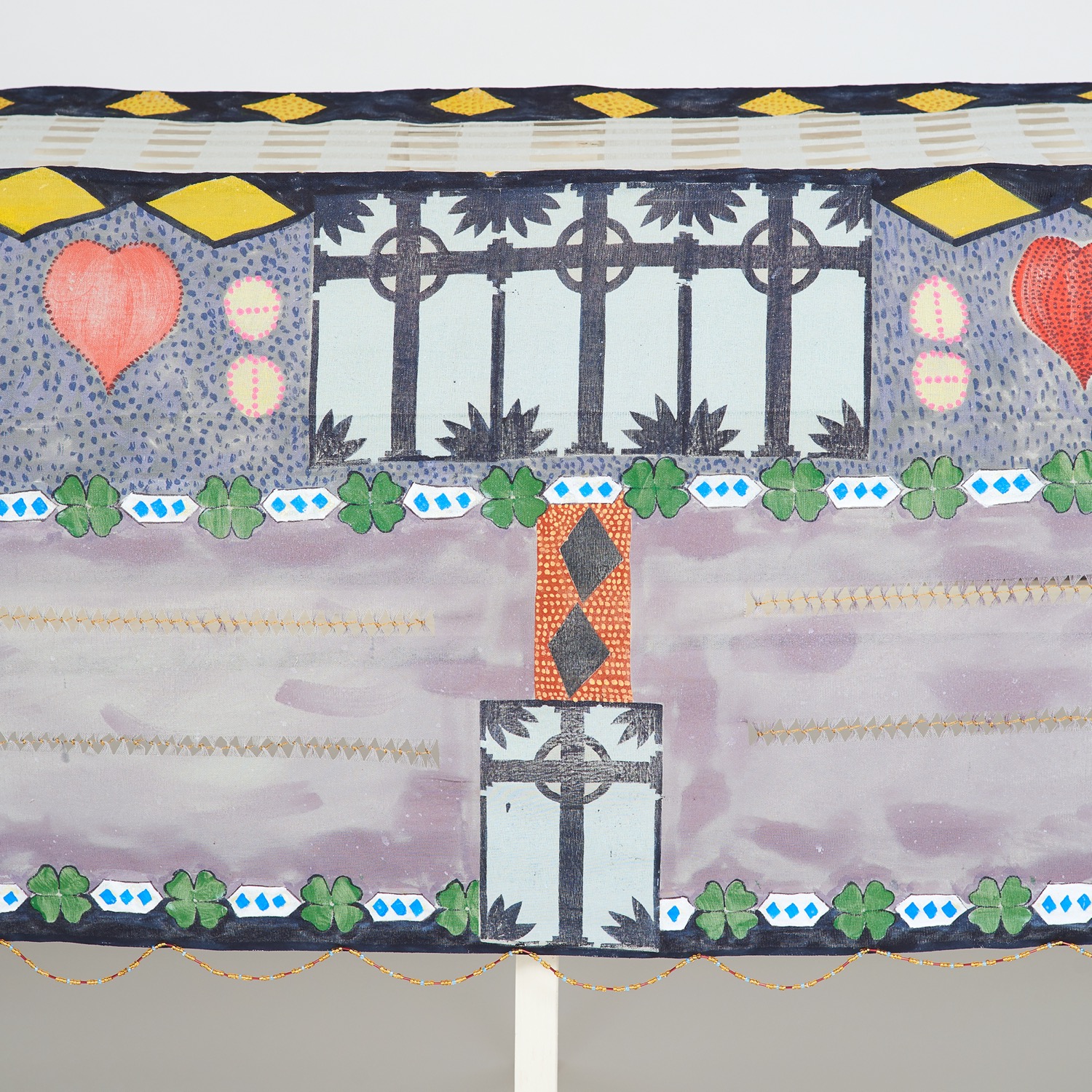
Vida, passion y muerte
2017
Acrylic, glass beads and metallic floss on muslin
27″ x 85″ x 28″
In mainline USA funereal rituals, a pall is often seen in two contexts: a white pall in a Christian service, or a USA flag in a military service. This Pall is a statement, a capsule, of a life lived with passion, struggle, and hope. The top is drawn-thread to give a partially cloaked view of the body.
My artwork is rooted in craft traditions informed by Judeo-Christian and Indigenous theology, art history, and ethnographic motifs. Their materials and processes are varied and inspired by textiles, world crafts, painting, embroidery, weaving, and carpentry. The resulting aesthetic is an intricate and multi-layered synthesis of figuration, abstraction, and decoration. The meanings that unfold are emotional, social, philosophical, and personal. My hope and vision are to bring Christian themes into the contemporary art world as a relevant subject of discourse. I am inspired by how various peoples interpret beliefs and in the many ways they are represented through ritual and artifact.
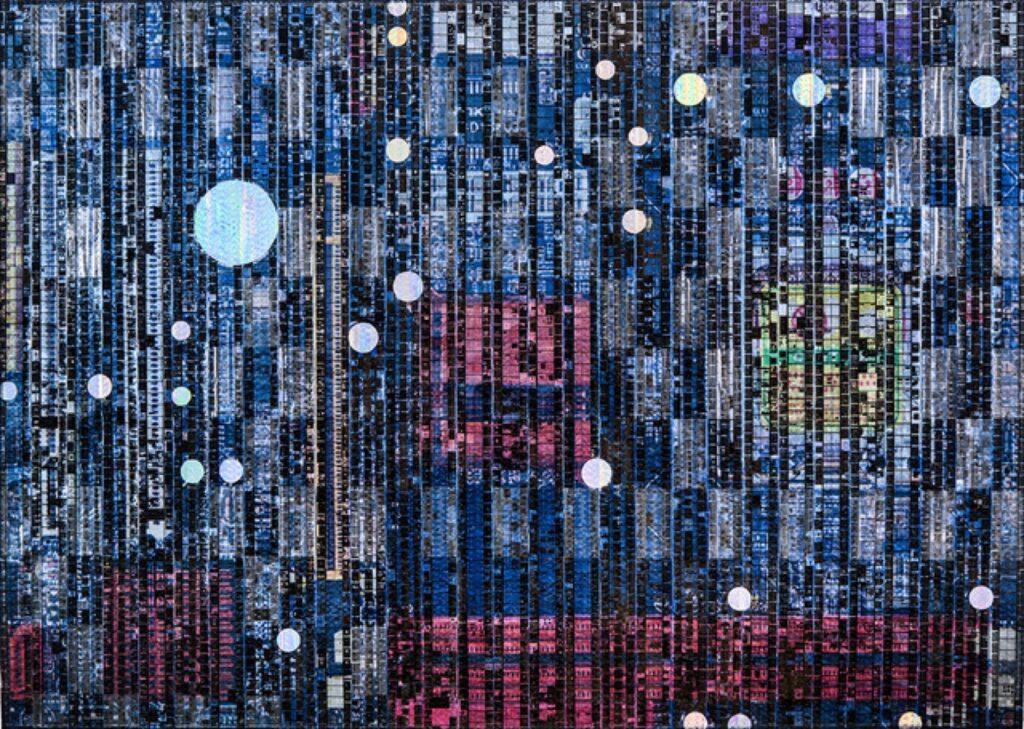
Arturo Alonzo Sandoval
Pattern Fusion No. 20: Motherboard 11 (Blue)
2018
Machine stitched, interlaced, layered and appliqué; digital specialty perforation tape, recycled auto industry Mylar, polyester film, recycled library 35 mm microfilm, monofilament and cotton threads, Holographic tape, Pellon, polymer medium, and fabric backed
42.25″ x 59.25″
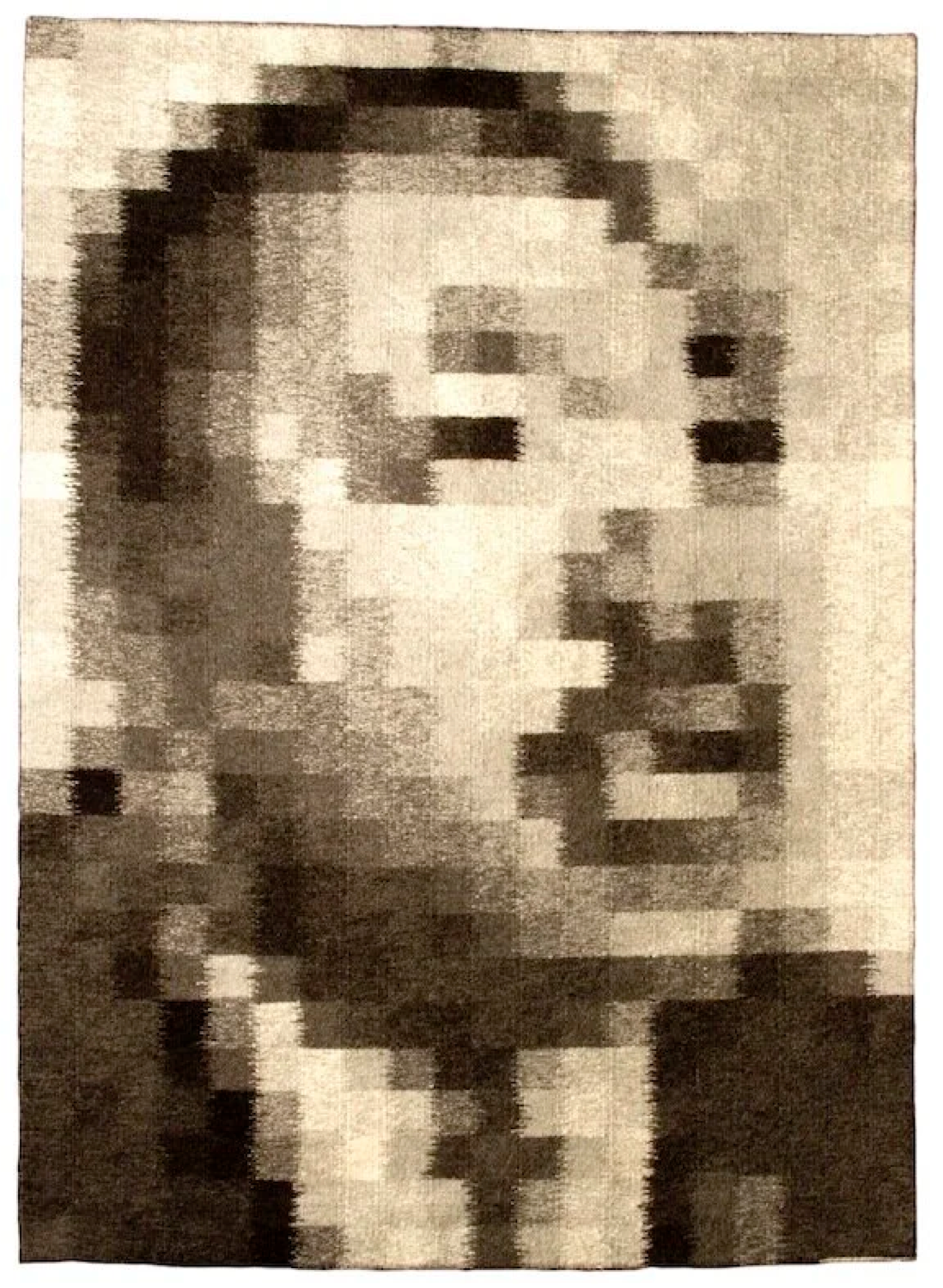
Michael F. Rohde
Dream
2014
Handwoven tapestry: un-dyed alpaca
For some time my work has been rather geometric, but often with concepts behind the shapes and colors. “Dream” is one of a series of handwoven tapestries that start with a photo, which is transformed to large pixels, that are woven. Many from this series took subjects who were inspirational examples for me and many others. Mostly, I gave the tapestries titles which gave clues to the original subject, and encouraged viewers to contemplate what they were seeing.
The medium in which I choose to work is fiber, primarily flat woven pieces. I’ve picked this less than common medium, having been drawn to the possibilities of relationships between subliminal texture and the interaction of light and color.
Having taken this route, the weavings can become an embodiment of the freedom to explore how colors relate to each other and to the surface properties of the fibers used. Pure color and specific color combinations of color have the power to speak to each of us, often producing differing responses in each person. By limiting the vocabulary to color and woven texture, the works are better able to stimulate reactions and emotions that these raw color and spatial relationships can have on the viewer.
Recent pieces of work over the last several years have addressed the impact of human and natural causes on the homes and lives of people. These include houses that disappear into the sands of war, are filled with rising flood waters or simply vanish as the natural consequence of time. One set of recent work is a group of tapestry woven pixelated faces, touching on abstraction and reality at the same time. Most recent is a set of large scale “Imagined Language” tapestries.
Yet, without the foreknowledge of what is behind the creation of these images, the works stand as objects of quiet beauty: begun with white yarns of wool, silk, linen and other fibers, I add my own dyes to achieve a range colors and contrast not available in commercially dyed materials. Like a painter, I mix my own colors to create something new.
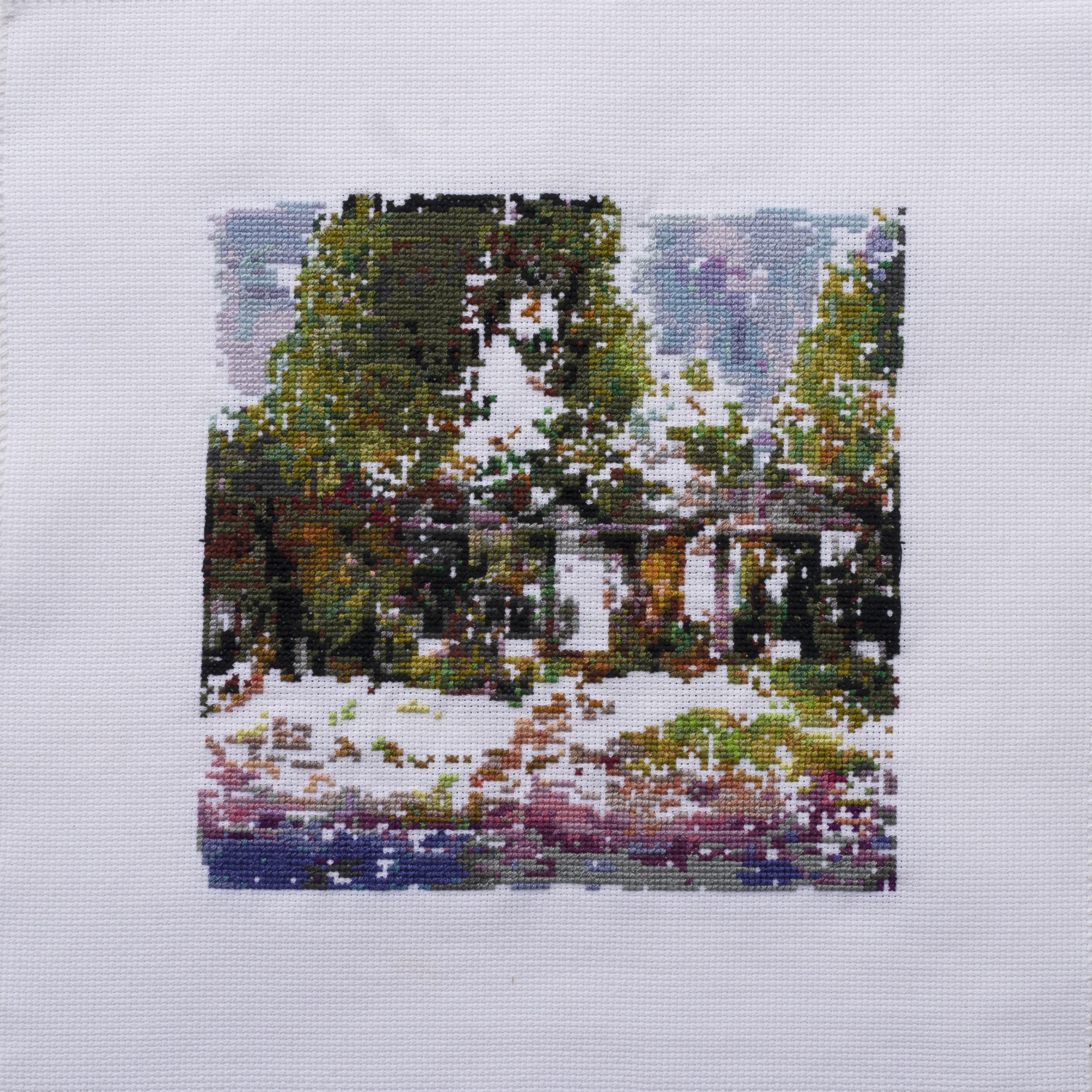
Michelle Robinson
Valley House 50.040
2022
Cotton cross stitch on 18 pt Aida
No Place
The project No Place is a meditation on the frangibility of memory of home. I trained a naive Generative Adversarial Network AI using a data set composed solely of my own photographs of suburban neighborhoods I have lived in. I pulled several stills from the AI’s evolutionary sequences, which started with an undifferentiated wall of pixels and ended with something nearly recognizable as a house. I then transposed these uncanny images by hand into small cross-stitched pieces and embroideries, using stitching as an analog equivalent to the pixel. Through repeated acts of tender translation between myself and the AI, between digital generation and painstaking analog labor, I am generating a feedback loop that both loses and gains information along the way. The glitchiness of my memory is reflected back at me as I make and remake my childhood home.
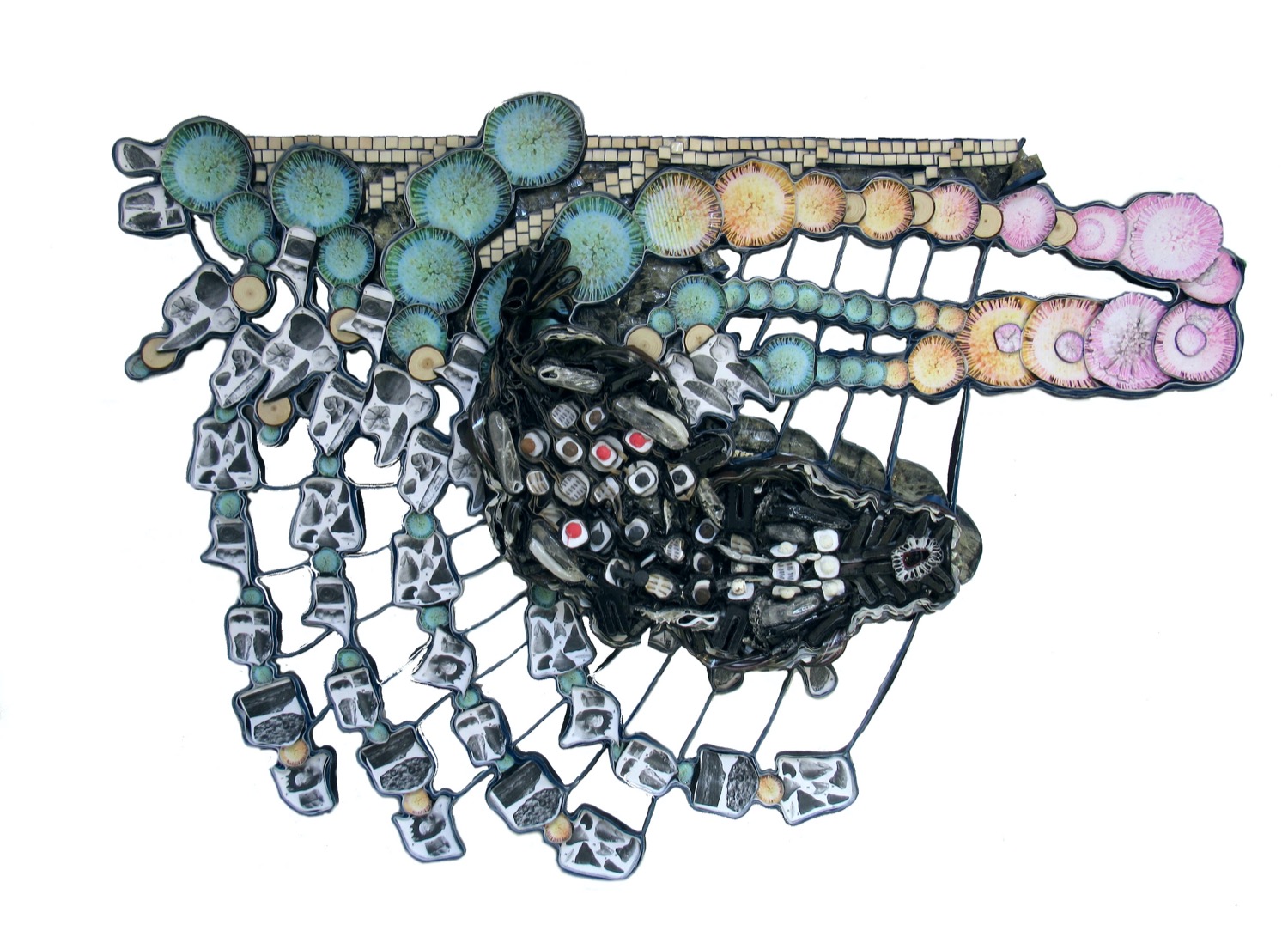
Alicia Piller
Remains. Tectonic forces. Vanished seas.
Vinyl, recycled screen printing ink on masking tape, latex balloons, gel medium, pine wood, sycamore seed, resin, laser prints (Button bush plant, Mississippian fossils from Missouri, & sycamore seeds), crystal.
67″H X 94″W X 5″D
My work draws from the structures of cellular biology to locate the root of human histories, using material as both subject and language. Through sculpture and installation, I construct layered systems where macro and micro perspectives collapse, revealing how bodies, environments, and social conditions shape one another over time.
Materiality is central to my process. I work with recycled textiles, industrial fragments, xeroxed imagery, resin, latex, and natural elements, combining them through acts of wrapping, binding, casting, and accumulation. These materials carry memory. They are cut, braided, and encased into membrane-like forms that build into larger organisms. Each work becomes a physical manifestation of thought, memory, and historical residue, suspended between construction and decay.
My practice is grounded in craft traditions passed through my African American maternal lineage and an ethic of repair inherited from my Jewish American paternal background. These influences shape my approach to sculpture as a site of transformation, where inherited knowledge and lived experience converge. My background in painting and anthropology further informs an ongoing engagement with global craft, material culture, and systems of meaning.
Increasingly, my work expands into immersive and suspended environments. These installations function as porous ecosystems, allowing viewers to move around and through them, encountering forms that shift between the bodily, the architectural, and the cosmic.
Across my practice, I investigate trauma, adaptation, and repair. The work holds rupture alongside resilience, proposing new ways of understanding how histories are metabolized and carried forward through material form.
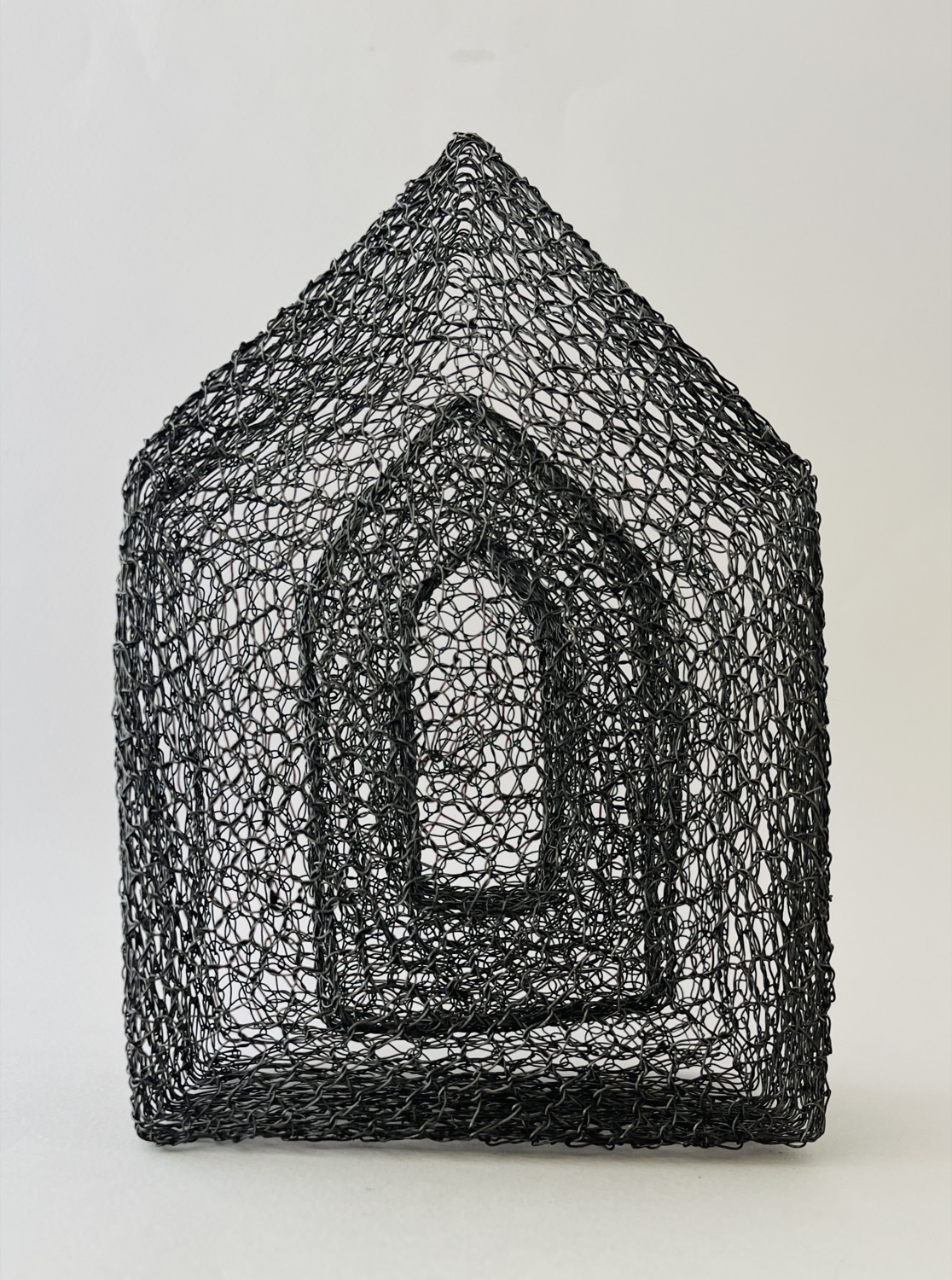
Lydia Tjioe Hall
Hollow House Within
2025
Steel wire
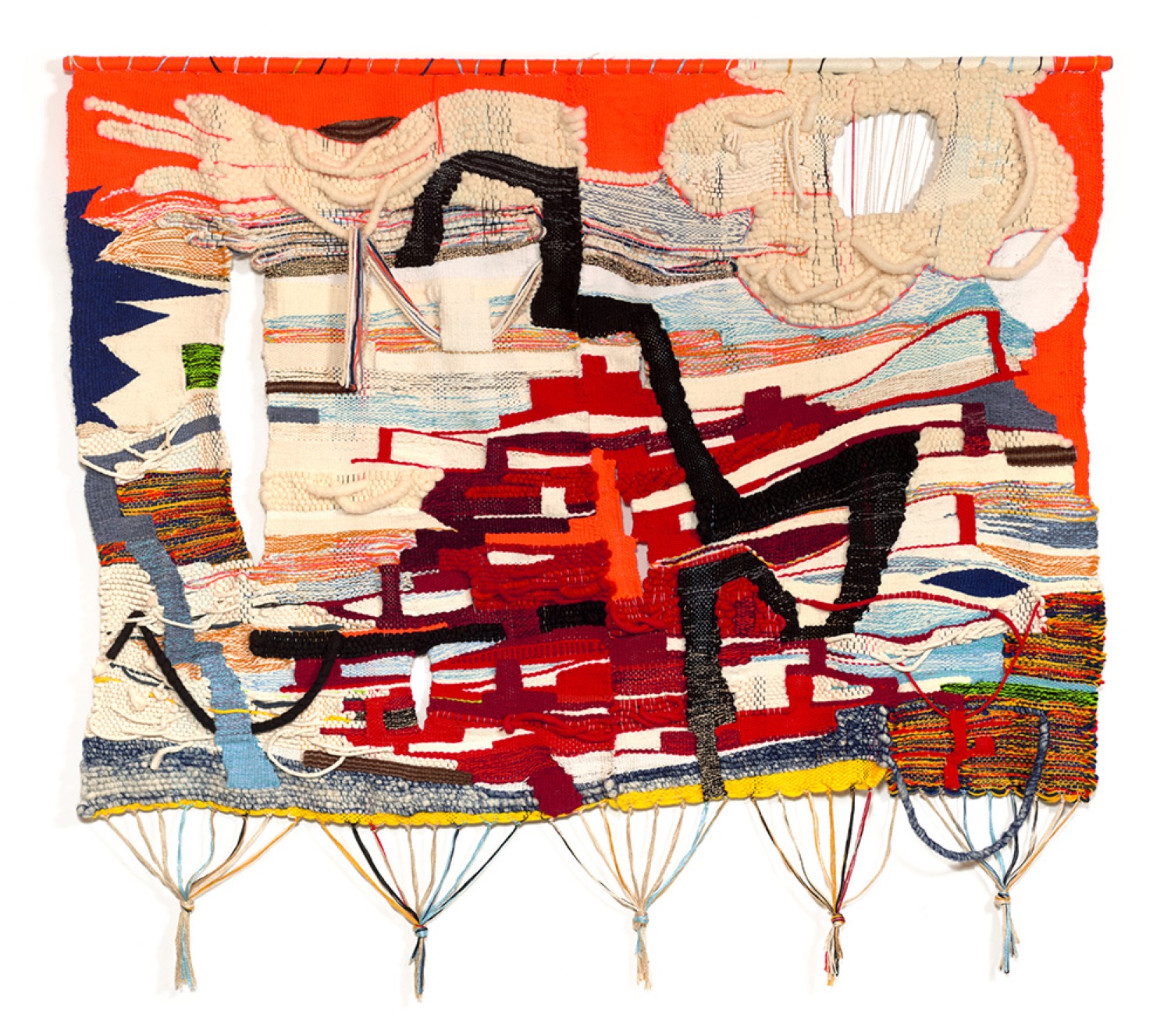
Terri Friedman
Stay Astonished
2018
Wool, cotton, acrylic, metallic fibers
Hello Uncertainty
Stay Astonished and Oxytocin are part of a series created after the 2016 presidential election culminating in an exhibition titled ‘Hello Uncertainty’, 2019. They document the climate of anxiety and uncertainty we experience collectively. And, despite a corrosive environment around us, how do we live with heartbreak and gratitude at the same time? The works are purposefully optimistic. Oxytocin is a ‘happy’ hormone that our bodies produce. The piece has an upside down rainbow smile that slides off the piece. Stay Astonished is framed in by a neon orange sky inciting a similar excitement but also anxiety.
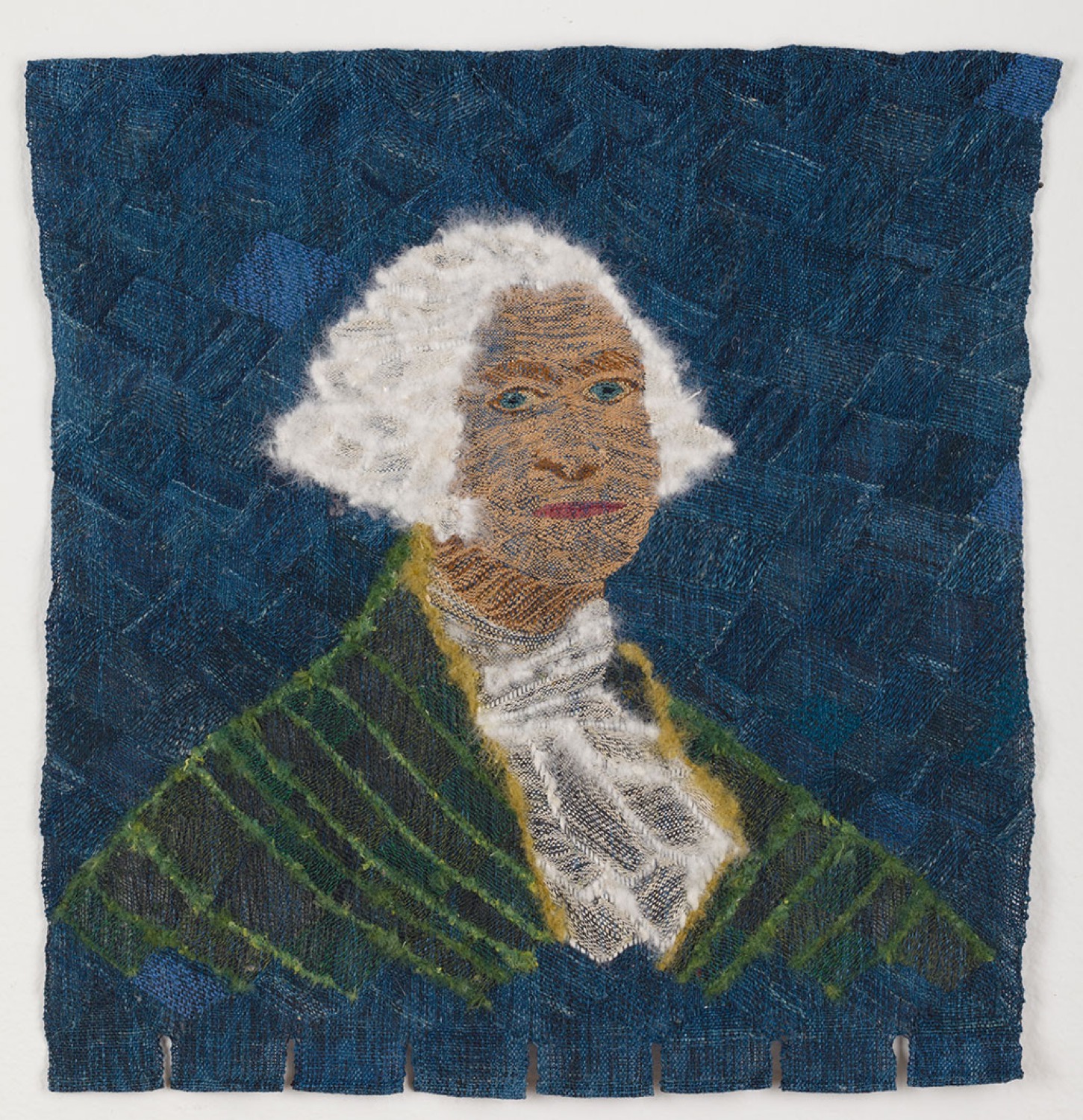
James Bassler
George Washington
2016
Indigo dyed linen, Coyuchi cotton, duck feathers and down
Wedge-weave and tapestry
Courtesy of the Artist and Craft in America
A George Washington woven portrait seems like, a natural, to be included into an exhibition dealing with 250 years of American history. There are interesting circumstances I would enjoy sharing with you, that allowed George to be woven.
In 2015, I was invited by the Director of the Museo Textil de Oaxaca, Mexico to join a small group of textile artists to explore the use of feathers in Mexican weavings from the 16th and 17th centuries. Those who were interested were given reading material and images of what had been made, long ago. Since there was to be an exhibit at the end of the year, each participant was given ample supplies of duck feathers, duck down spun into yarn, duck wing feathers, large and flat. Many had been dyed a variety of colors.
Once the indigo dyed linen warp was on the loom and a portion of the background was woven it was time to determine the actual size of the figure to be tapestry woven. I made a few enlarged images of George Washington as a template, that were taken from the image we see on our dollar bills. I was now ready to enter unknown territory to determine what yarn, and which feathers to consider using. To help with this daunting decision I must thank, Lin-Manuel Miranda, author and director of the musical “Hamilton”, which, at the time, had just opened on Broadway. From the images I had seen on tv and in print, one could see that at least 50% of the cast, playing roles based on the framing of our new government, were Black. Perfect! This inspired me to use one of my favorite yarns– a natural brown, hand-spun cotton, from Oaxaca, called Coyuchi. This rich brown cotton became George Washington’s skin color and creates a dramatic contrast to the ever so white duck feathers that surround his face. The incorporation of the Coyuchi yarns and an ancient Mexican technique of using yarns composed of spun feathers as the basis for George Washington speaks in a subtle way about the foundation of the American experience built on native knowledge.
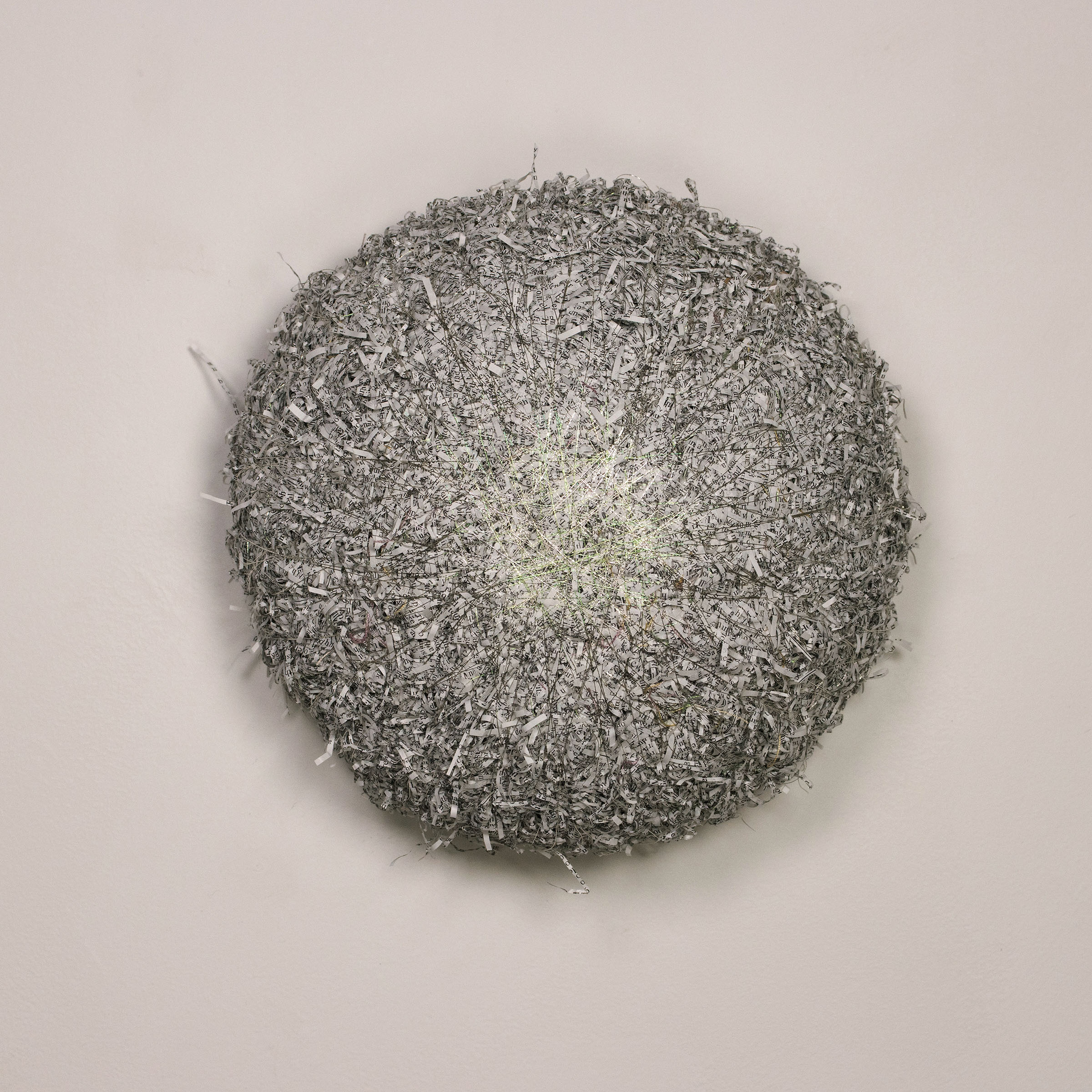
Linda Ekstrom
Hemisphere
2003
Altered Bible, thread, wax
The Bible text is coated in beeswax and formed into a hemisphere, then wrapped in silvery threads to create a cosmic icon. In many cultures, beeswax was honored as sacred and represents the symbol of light, purity, and healing.